

When you set out on a photography trip, you pack your gear, mark the famous viewpoints on your map, and plan your shoot times down to the minute. That's Part 1 of being a travel photographer. But something magical happens when you step off the planned path and actually see what is in front of you. That is where the real art of your craft becomes your self in the world. Travel and photography are not merely about getting to a place and imaging it; they are also about remaining in the moment at all times, and learning to be as aware as possible of everything the world is presenting to you.
In our first article, Travel Photography Tips for Capturing New Places, we covered the importance of research, timing, and intentional composition. Those foundations matter. But here's what we've learned after years of traveling with cameras: the best images often arrive unplanned. They come to those who are present and alert, ready to recognize beauty in the spaces between the famous shots.
This is not about luck. It is about the conditions that make luck visible.
What Serendipity Really Is
Serendipity in travel photography is not stumbling blindly onto a perfect moment. It is preparation meeting openness. You know how to compose. You understand light. You can read a scene quickly. Now you add one more skill: the willingness to wander, to notice, to stay curious about the ordinary.
We discovered this in Denver Union Station, a place most travelers pass through without a glance. But we lingered. We watched how light moved across the information board. We saw the geometry in the ticket windows, the warmth in the marble, the small human stories unfolding in a transit space. The station itself became a subject, not because we planned it, but because we were paying attention.
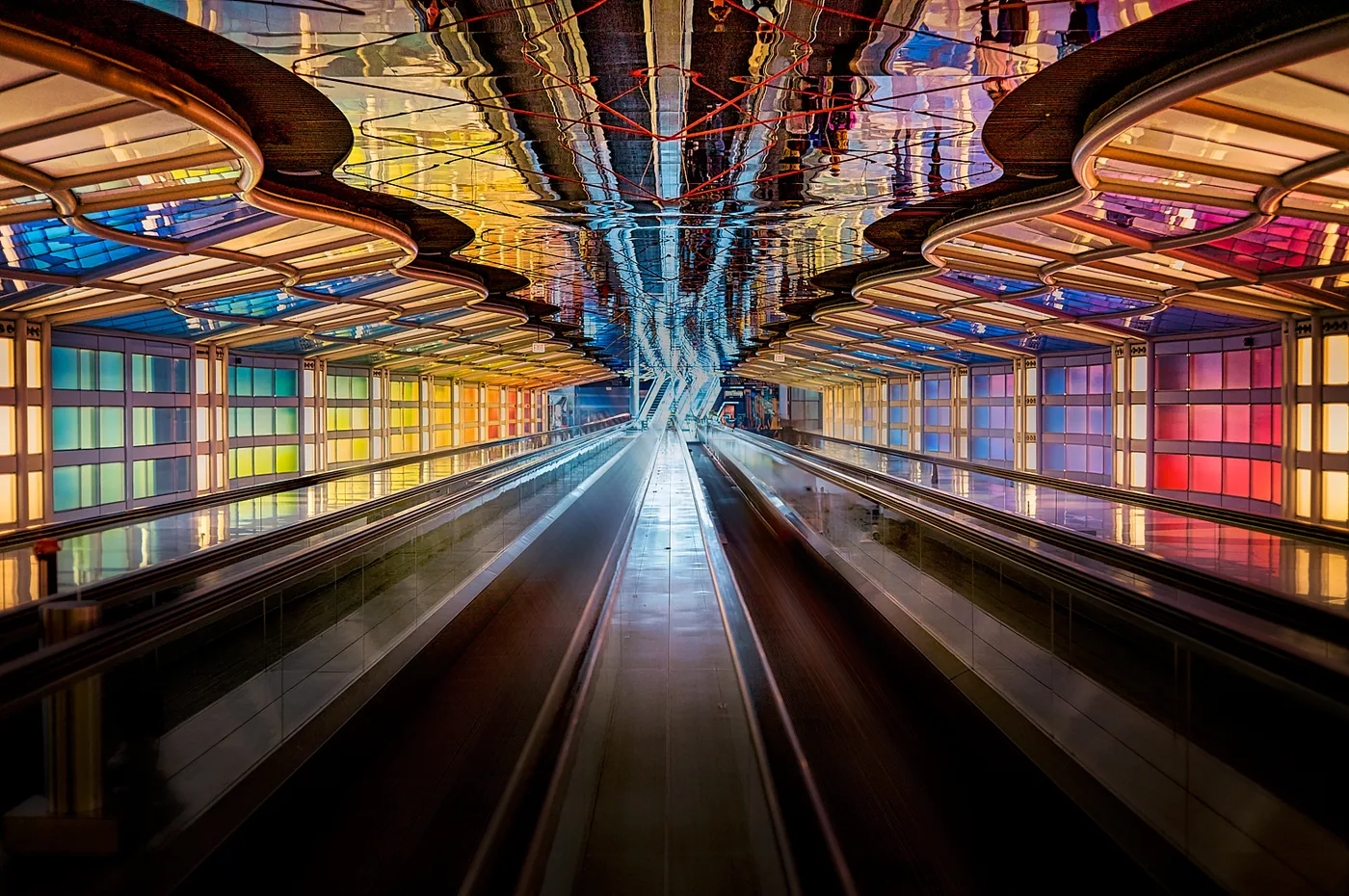
The same happened in the neon tunnel between terminals at Chicago O'Hare designed by Michael Hayden, and the title image of this article. It was supposed to be a walkway. Instead, the color, the repetition, the light created something that felt like an accidental art installation. We could have missed it entirely. Instead, we recognized it as a photographic moment because we were aware of what was around us.
Presence Over Planning
There is a difference between visiting a place and really seeing it. When you arrive at a famous landmark at the optimal time with the shot already visualized, you are executing. When you wander a side street, wait in a station, or pause at an unexpected corner, you are discovering.
Both matter. The planned shot anchors your work. The serendipitous moment often becomes the image you return to, the one that makes someone stop and feel something.
Presence means you are not rushing to the next location on your list. It means you notice the quality of light on a riverside path in More London, how urban geometry creates rhythm and shadow. It means you see how an ordinary scene can become extraordinary if you wait, watch, and stay ready.
This requires discipline in a different way. You have to resist the urge to optimize every minute. You have to build space into your schedule for wandering. You have to trust that the camera is ready, that your eye is trained, and that if something reveals itself, you will recognize it.
Timing and Readiness
Sometimes serendipity is about being at a place just when something happens. We've learned this through experience. Being at Mono Lake in the nick of time meant arriving as light hit the landscape in a way that would never repeat exactly that way again. We could have left an hour earlier. We could have stayed at the hotel. Instead, we were there, watching, waiting for the next shift of light.
This kind of readiness comes from:
- Staying flexible about your schedule, even if you planned carefully
- Returning to locations at different times of day and different seasons
- Keeping your camera accessible, not packed away
- Knowing the technical settings well enough that you can adjust quickly
- Staying alert for changes in weather, light, and composition
When you travel with this mindset, you are not just photographing places. You are in conversation with them. You are showing up ready to listen.
The Space Between Intention and Discovery
The most interesting photographs often live in the space between what you planned and what you found. You went to a location for one reason, and something else caught your eye. You were waiting for sunset and light moved across a wall in an unexpected way. You were walking to a famous viewpoint and discovered something more personal around a corner. You took an unplanned turn and found something unexpected.
This is where travel photography tips become less about rules and more about intuition. You need the foundation of composition and technique, but you also need the freedom to break your plan when something real appears.
We think of this as the threshold in our work, a repeated visual structure where the viewer stands before a passage, a window, an opening. But thresholds appear everywhere: in architecture, in landscape, in light itself. A doorway in a station. A corridor of neon light. A bridge opening toward a view. These moments ask you to step through, to see what lies on the other side.
Building a Practice of Openness
How do you cultivate serendipity? It starts with a shift in how you approach a trip.
- Plan your major shoots, but leave 40 percent of your time unscheduled
- Visit a location, then return without a specific shot in mind
- Walk the spaces between famous landmarks
- Pay attention to how light changes throughout the day
- Photograph the same scene from different angles and distances
- Notice the small details: a reflection, a shadow, a color harmony
- Stay in places longer than you think you need to
Serendipity rewards patience and attention. It rewards the photographer who stays present even when nothing seems to be happening. And then, suddenly, it is.
Bringing It Home
What you discover in travel becomes the art that lives in your space. The image that surprised you, that you found by chance but recognized because you were ready, often resonates most deeply. It carries the energy of discovery. It tells the story of being alive and awake in the world.
When you display landscape, travel, and nature photography in your home or workspace, you are not just hanging a beautiful image. You are inviting that feeling of passage, of moving through a threshold into something larger. You are reliving the moment you stepped off the planned path and saw something you were not expecting.
That is what Hammond Raffetto Art is about: capturing images that embody that movement from the ordinary into illumination. Our travel and landscape photography draws on years of being present, of wandering, of staying ready for the moment when a place reveals itself.
The next time you travel with your camera, give yourself permission to deviate from the itinerary. Stay longer in one place. Wander a street you did not plan to visit. Pay attention to the spaces between the landmarks. You may find that the best travel photography tips are the ones that teach you to see again, and to trust what you find when you are truly present.