

We learn urban landscape photography the way we learn landscape photography: by standing in a city long enough, and at the right hour, for it to show us something we could not have anticipated or composed at will. That hour is almost never the hour when the city is full of people doing what cities are for.
Let's start with a distinction that matters. Street photography and urban landscape photography are not the same thing. Street photography is about people, the decisive moment, the human story playing out on a sidewalk or corner. A street photographer is looking for gesture, interaction, the life of the city as it moves through it. Urban landscape photography treats the city the way landscape photography treats a mountain range or a forest. The subject is the city itself, not what the people inside it are doing. The subject is light, form, architecture, geometry, and the way time moves through space. A city at dawn, empty and compositionally available, is as much a landscape as Yosemite Valley or the Eastern Sierra.
We do not distinguish between the natural world and the built one when we are working. A glass tower catching the last horizontal light of the afternoon is doing the same thing a granite mountain is doing. The city is a landscape. It has its seasons, its light, its fleeting moments that reward the photographer willing to show up and wait.
Why Cities Reward Early Rising
Cities have a secret that most people never see. The blue hour before dawn in a city like Chicago produces a quality of light that has no equivalent at any other time of day. The last of the night sky deepens above the skyline while the buildings hold their own illumination. The river lies flat and still before the first boat traffic ripples it. The streets are empty. The air is cool and clear.
A city at that hour is as empty and as compositionally available as any wilderness. The photographer willing to be there is rewarded with the city's version of the fleeting natural moment. We have spent many mornings in Chicago waiting for the light to arrive, watching the sky shift from black to indigo to a purple so deep it seems impossible. This is when the Chicago River District skyline holds a particular magic: the city still holding its breath before the workday begins, with a quality of presence that no afternoon visit can replicate. The composition reveals itself slowly, as the sky changes and the building lights shift in relation to the emerging daylight.
The same principle that makes us wake before dawn in the mountains makes us wake before dawn in the city. There is a window. It closes. The light is happening now, and if we are not there, we will miss it entirely.
The Compositional Challenge of Urban Density
A mountain or a forest has an inherent simplicity. You can often see the subject clearly, with space around it and sky beyond. A city fights simplicity. Glass, steel, geometry, reflections, and visual complexity crowd every frame. The challenge of urban landscape photography is filtering the city's visual noise until the essential composition becomes legible.
We look for the same compositional elements in a city that we look for in a landscape:
- A strong foreground that anchors the frame
- A defined subject that draws the eye
- Negative space to let the subject breathe
- A light direction that reveals form rather than flattening it
- Leading lines that move the viewer through the image
In the mountains, negative space might be sky or water. In a city, it might be a cleared plaza, a bridge, a patch of sky between buildings, or even the flat surface of a river. The principle is the same. The eye needs room to move, and the subject needs silence around it.
Grand Central Terminal offers a perfect example of how to approach interior civic architecture as a distinct kind of urban landscape subject. Grand Central Terminal in the afternoon light reveals the great hall as landscape, the ceiling as sky, the commuters as incidental weather. The space itself is the subject, and the light is the revelation. The architectural geometry becomes as important as any natural formation, and the challenge is the same: find the angle, wait for the light, compose the form.
Light at Twilight: The Technical Window
The most specific technical challenge of urban landscape photography is the layering of artificial and natural light at twilight. The buildings are lit from within. The sky is still illuminated by the last of the sun. For a brief window, both light sources are balanced. The exposure that retains the sky while letting the buildings glow from within is possible, but the window is narrow. It closes as fast as golden hour closes in the mountains.
We are often working with a difference of several stops between the sky and the buildings. The sky might be a rich blue or purple, and the lit buildings might be gold or cool white. To hold both in the same frame without losing one to overexposure or the other to shadow, we use a combination of exposure bracketing, neutral density filters, and careful metering. Some photographers use blending techniques in post-production. The goal is always the same: capture the moment when the city is most itself, when both the natural and artificial light are singing in agreement.
This window might be five minutes. It might be ten. Then it closes. The sky goes black, or the blue fades to gray, or the buildings' lights overwhelm the remaining daylight. The photographer who understands this rhythm, who knows when to be in position and what to watch for, can work this light deliberately. The photographer who arrives as an afterthought will find nothing left to photograph.
Seeing the Familiar from an Unfamiliar Angle
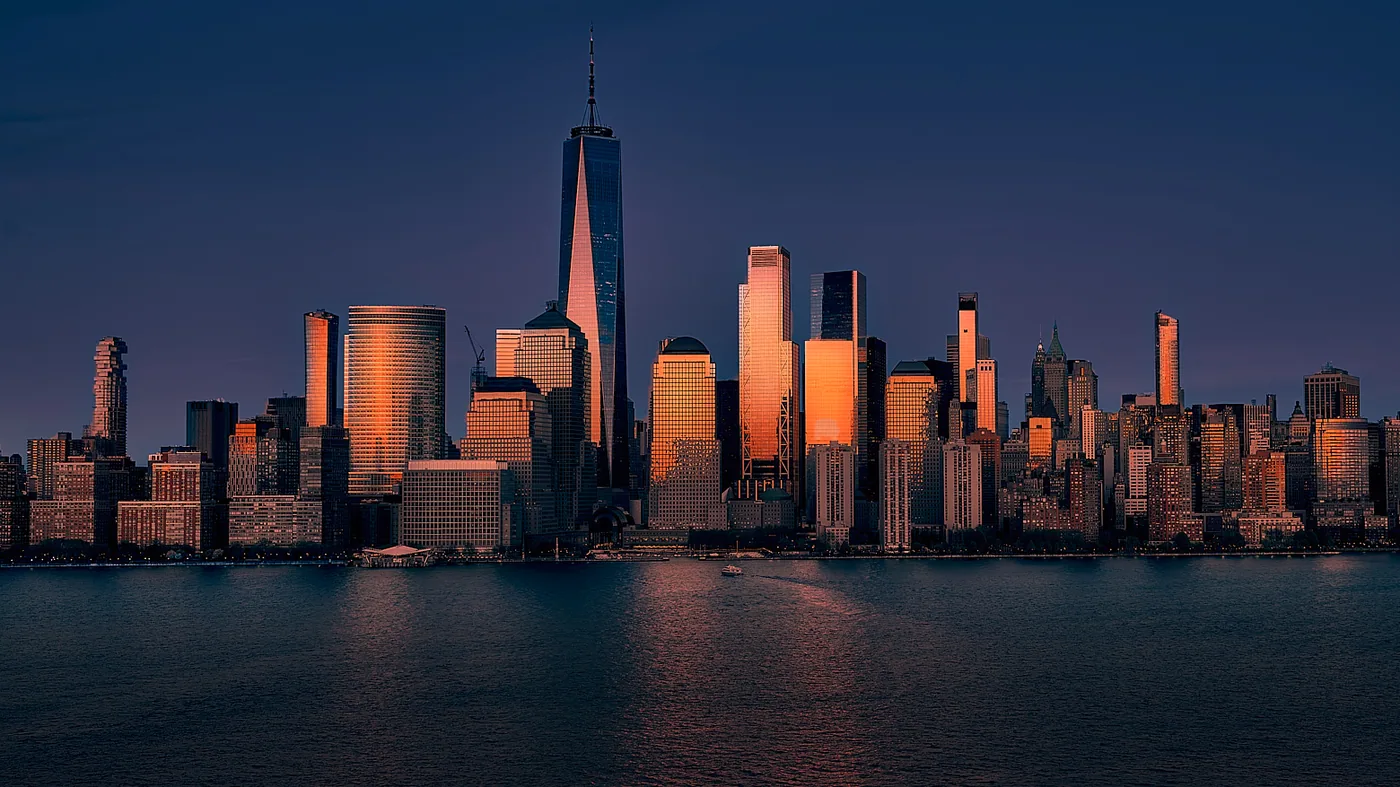
One of the greatest gifts of urban landscape photography is the opportunity to approach familiar subjects from unexpected angles. We have all seen the New York City skyline a hundred times, in movies, in photographs, in postcards. But the New York City skyline at sunset from Exchange Place, New Jersey, shows the view the city saves for photographers willing to cross the water. The familiar subject becomes new when the light is right and the angle is considered.
This principle applies to any recognizable cityscape. The challenge is not to find a new city, but to find a new way of seeing a city that others have already seen. We ask ourselves: Where is the light coming from? What happens if we are lower, or higher, or on the opposite side of the water? What happens if we wait until the moment others have packed up and gone home? A famous landmark photographed at the hour everyone expects to see it photographed can be striking. Photographed at the hour no one thinks to look, it becomes revelatory.
Why Cities Matter as Subjects
Cities are not a second choice for photographers who cannot access wilderness. Cities are a legitimate and inexhaustible subject in their own right. A city is human intention made visible. It is engineering, aspiration, history, and light all in conversation with one another. A mountain does not decide to be beautiful. A city, in some sense, does. Every angle, every material choice, every light fixture was decided by humans trying to create something of value.
For a deeper understanding of the architecture and built environments we photograph, resources like ArchDaily offer documentation and context that can enrich how we see a city's structure and intention.
When we photograph a city, we are not photographing nature. We are photographing human nature, human ambition, human skill at making something that will outlast us. There is something redemptive in that, in finding beauty in what we have built and in revealing that beauty to others through the light that moves across it.
The Practice of Patience
The photographer who learns to see the city as a landscape, not a backdrop or a convenience, will find a subject as inexhaustible as any wilderness. Every day the light is different. Every season the city presents a new face. The same bridge photographed in January and June might as well be two different places. The same plaza at 5 a.m. and 5 p.m. is two entirely different compositions.
This requires the same commitment that landscape photography requires. It requires showing up early. It requires learning to read light. It requires patience, returning to places across days or seasons before settling on a composition that feels true. It requires being willing to be somewhere alone, in the cold, waiting for a light that might not come. It requires accepting that most attempts will fail, and that failure is simply the cost of the rare moment when everything aligns.
The city rewards this. The city always has something new to teach the photographer willing to look deeply enough, and the photographer willing to be there when the light is honest.