

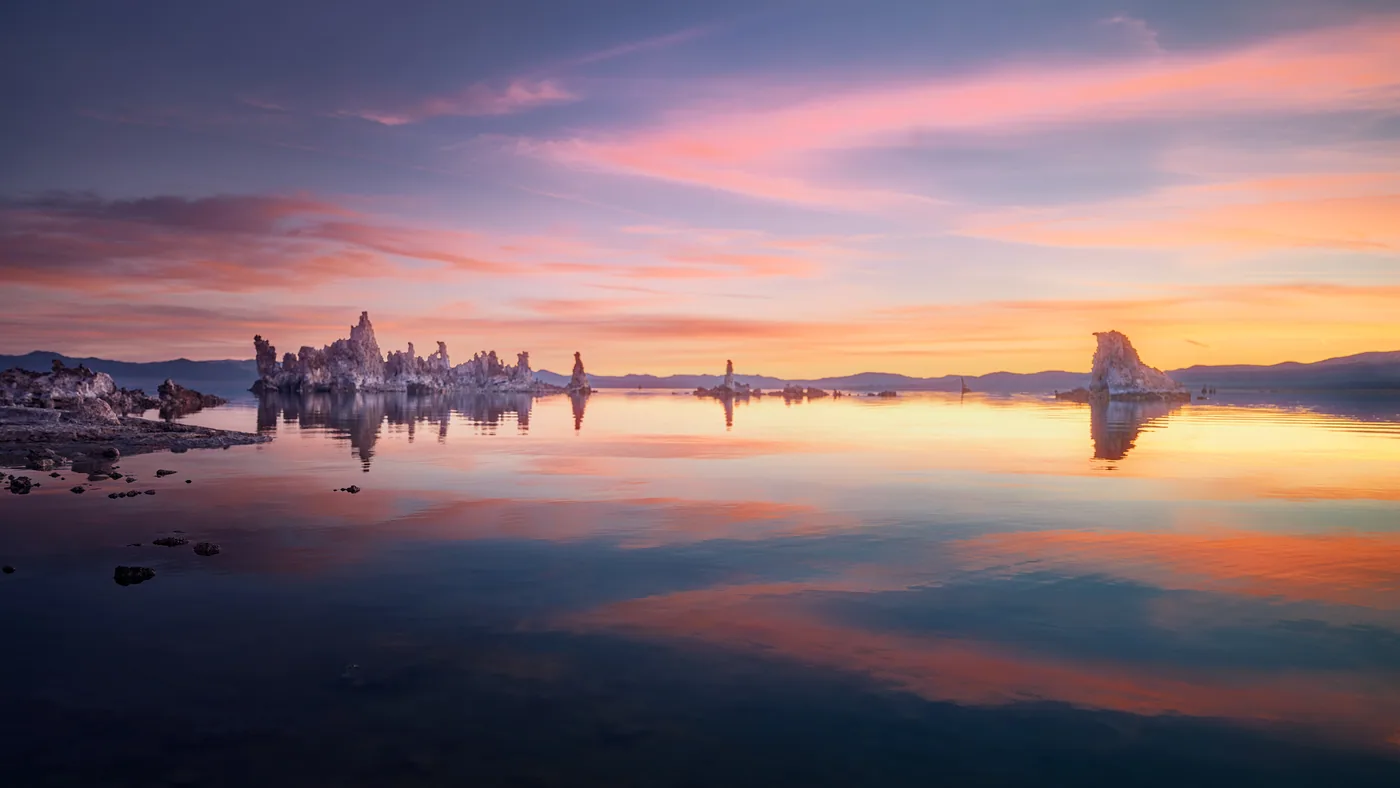
We have stood on enough lakeshores before dawn, waiting for wind that never came, to know that a perfect reflection is closer to an accident we have learned to put ourselves in the path of. The technical conditions align so rarely, and when they do, the window closes fast. Yet it is precisely this fragility that makes reflection photography so rewarding. A mirror on water demands patience, observation, and an honest read of the physics happening right in front of us.
The Physics of a Reflection Worth Photographing
Three conditions must converge for the reflection to sing. First, the water surface must be genuinely still, with no wind-driven ripples breaking the plane. Second, the water column beneath the surface needs to be dark enough that light bounces off the surface rather than penetrating down and scattering back up through the image. Third, the angle between your camera and the water must allow you to catch the light reflecting off the surface at the angle of incidence that your lens occupies.
All three rarely happen at once. A lake might be calm, but the bottom might be pale sand that broadcasts light in all directions, flooding the reflection with scatter. The angle might be perfect, but a breeze kicks up across the water in the last thirty seconds before your shot. We learn to recognize when the conditions are truly aligned, and we also learn to accept when they are not. That acceptance becomes part of the practice.
The reflection itself is not just a copy of what sits above the water. The surface acts as a subtle filter. The reflected sky often reads more saturated than the sky you see when you look up. This happens because the angle of your camera captures the sky's light more efficiently at the water's surface than your eye does standing upright. The water's reflection is also slightly less luminous than the sky, tending to darken the colors and make them appear richer. The water is almost working like a lens, concentrating and intensifying the color of what it mirrors. A window as it were into what it means to be a color.
Why Dawn Reflections Outshine Sunset
We have learned to prefer dawn for reflection work, and the reason is atmospheric, not romantic. By sunrise, the air has settled overnight. Thermal currents from sun-warmed earth have not yet begun to rise and churn the lower atmosphere. The wind that will eventually ripple the surface has not yet woken. The world feels held in place. And the mirror it holds up to itself can feel deeper than reality.
Sunset, by contrast, comes after a full day of solar heating. The ground has been warming the air above it for hours. Invisible currents of warm air rise and cool air falls. These movements are subtle but visible to a camera when you are trying to hold a mirror-still reflection. The ripples are microscopic, but they scatter just enough light to blur the sharpness of what the water reflects. The thermal turbulence breaks the spell.
Dawn also offers the gift of predictability. The conditions are likely to hold for longer. We can compose carefully, watch the light change, wait for the right moment in the unfolding of the landscape. Sunset asks us to hurry before the light dies. In reflection work, rushing against the physics never wins.
Composition: Symmetry as Subject
The most direct approach to reflection photography is the equal horizon split. Place the horizon line down the center of your frame and let the reflection claim half the image. This symmetry does something powerful: it tells the viewer that the reflection matters as much as the scene above it. The lake is not merely a mirror for the mountains; the mountains and their reflection are equally weighted, equally important.
But symmetry itself can become the subject. When we stand before true reflection work, the moment we realize that we cannot immediately tell which half is the original and which is the reflection, the photograph shifts. We become aware of the mirror itself, the surface between two worlds. This moment of uncertainty is where the composition gains its strength.
The alternative approach is to weight the composition so that the reflection dominates. Pull the horizon line high in the frame and let the water occupy the majority of the image. This says something different: the story is happening in the water, not above it. The reflected sky, the reflected landscape, the subtle movements of light across the surface, these are what we came to photograph. The scene above the horizon becomes context, not subject.
Deliberate Interruption: When Disruption Helps
Perfect stillness is rare, and the moment something moves across the surface, the photographer must decide whether the interruption serves the image or destroys it. A duck crossing at the wrong moment, a leaf falling, a ripple spreading from a fish breaking the surface, a breath of wind that moves the water for just one frame.
We have learned that these breaks can work, but only if they add a point of genuine interest. If a bird lands on the reflected landscape, creating movement in an otherwise still mirror, the eye is drawn there. The photograph gains a sense of life and change. But if the ripple merely smears the reflection into blur, if the break feels accidental rather than placed, the stillness the image depended on has simply been sacrificed.
The question becomes: does this disruption tell a truer story about what happened at this moment? Or does it obscure the story we came to tell? Water is rarely completely still in nature. Sometimes capturing that near-stillness, the texture of the surface as it actually was in that instant, matters more than achieving glassy perfection.
Long Exposure and the Conversation Between Freezing and Smoothing
Technique in reflection work often comes down to a choice about exposure time. A fast shutter freezes the water exactly as it was in that single instant, every ripple and texture visible. A longer exposure smooths the surface, averaging out the tiny movements, and if the exposure is long enough, the water becomes almost glass, almost liquid mirror.
These are not neutral technical choices. They change what the photograph is saying about the moment. A frozen reflection captures reality as the camera sees it, texture and all. A smoothed surface, rendered by longer exposure, creates something idealized, a tree gazing upon itself, a transformation of the physical world into something more serene, more contemplative. The water becomes a lens, not just a surface.
Night reflection work demands longer exposures to gather enough light, and this naturally creates the glass-like quality that makes stars or planets hold their mirror image on the surface. That moment when Jupiter, Mars, and the Milky Way are considered by the tufa at Mono Lake at two in the morning captures both the planet and its reflection with equal clarity, that requires the long exposure and the utterly still water that comes before human activity begins.
When the Reflection Tells the Truer Story
We have learned that sometimes what the water reveals is more important than what sits above it. Mono Lake under lenticular clouds, the water holding a sky that would not last another minute, showed us that the reflection could record a moment of sky that dissolved almost as soon as the shutter closed. The water was not just mirroring the landscape; it was preserving something the landscape alone could not show us.
This is the distinction between photographing water and photographing what water reveals. A lake is scenery. Water is a lens. When we approach a still surface, we ask not just what is reflected, but what does the reflection tell us that the scene above it does not. When Queenstown harbor doubling the clouds, the water so still it was difficult to know which image was the original, we realized we were looking at two different kinds of sky simultaneously, two different moments of light, held in the same frame.
The lake itself becomes subject. The surface becomes the story, like the Mono Lake reflection . This shift in perspective changes everything about how we compose, how we wait, what we are actually looking for when we stand at the water's edge.
Standing at the Threshold
Reflection photography asks us to understand water not as obstacle or setting, but as a surface that separates and connects. It divides one world above from one world below, and it also joins them, mirrors them, holds them in conversation. We become aware of the threshold itself, the place where light changes direction.
This is why we return to the same lakes and rivers across seasons, waiting for the light and the stillness to align. This is why we rise before dawn. The reflection is not the landscape twice over. It is the landscape revealed differently, seen from a new angle, told in a language of light and surface that asks us to look more carefully, to understand that the world is not flat, not singular, and not as fixed as it appears. For reflection and water photography made to the highest standard, National Geographic's photography section remains the benchmark.
When you approach water as both mirror and subject, when you understand the physics that allows a reflection to hold at all, when you wait for the moment when the surface becomes clear enough to see through it into something else, you are not just making a photograph. You are documenting the remarkable fact that the world reveals itself in more than one way.