

When you stand before a sweeping vista, the view often feels impossibly wide or tall. Your eyes take in details from far left to far right, down and up, registering scale and distance with your brain in ways a single frame struggles to capture. Panoramic photography can solve this problem. It lets you record the full grandeur of a landscape by combining multiple images into one cohesive, expansive composition. Now, before we go any further, let's dispense with one item. This isn't about using panoramic mode on your phone. Don't get me wrong; panorama phone photography is a brilliant innovation. And, when the only camera you have is the phone in your pocket, well . . .. But if that's all you have to work with, then you probably don't need to worry about the rest of the information in this piece. By all means, if what you want is a picture of the General Sherman sequoia in its entirety, flip your iPhone horizontal and pan upwards. You'll get a shot of the tree. And maybe that's the only shot you need or want to trigger those sense-memories. But if you're serious about telling a story with a panoramic image, read on.
Panoramic photography is not a single technique but a philosophy of composition. Whether you're shooting the redwood forests of northern California, the misty valleys of Burgundy, or the dramatic peaks of Yosemite, learning to think panoramically opens up new ways to reveal the beauty in front of you.
Why Panoramic Composition Matters
A standard rectangular frame often feels too narrow for the scenes that move us. When you're standing in front of a landscape that demands your attention from horizon to horizon, a wide angle lens still doesn't capture the emotional truth of what you're experiencing. In fact, a wide angle lens often makes the composition worse by diminishing distant subjects that might be critical to the human perception of awe.
Panoramic photography changes your relationship with the landscape. Instead of fighting the constraints of a single frame, you lean into the width of a scene. This approach is especially powerful when shooting:
- Mountain ranges that stretch across your entire field of vision
- River valleys and canyons where the journey matters as much as the destination
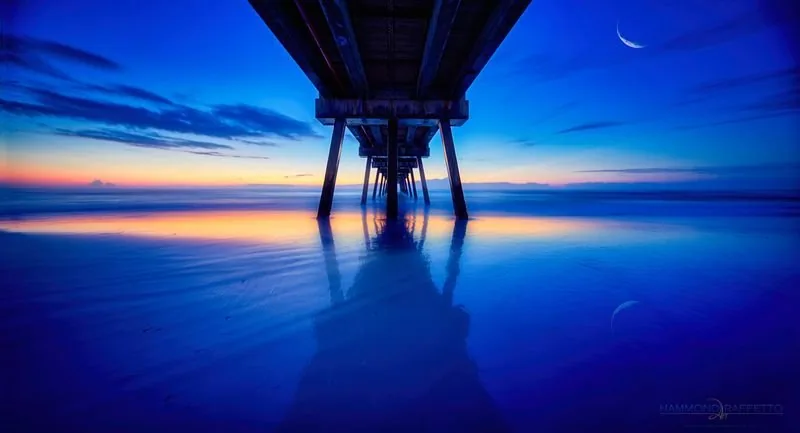
- Seascapes — like Ultramarinus, the 15-frame pre-dawn stitch shown above — and coastlines where the format captures width impossible in a single frame
- Forest canopies where light filters through trees spanning left to right
- Urban skylines and architectural details
When you commit to a panoramic format, you're making a deliberate choice about how to present the world. You're saying: this landscape is fundamentally about width, about the breadth of what we can see and feel.
Understanding Panoramic Composition
Wide angle landscape photography and panoramic photography are not the same thing. A wide angle lens captures more of a scene in a single shot. Panoramic photography stitches multiple frames together to create something larger and more immersive.
Before you even touch your camera, think about what makes this scene panoramic. Is it the horizontal expanse? A clear leading line that draws the eye left and right? Layered elements that reveal themselves as you scan across the frame?
Composition rules still apply. Look for:
- A strong foreground that anchors the left side of your image
- A clear middle ground where the main subject lives
- A compelling background or sky that completes the right side
- Natural lines, like rivers or ridgelines, that guide the viewer's eye across the width
The best panoramic compositions use these elements to create a journey, not just a view. Your eye should want to travel across the entire width of the image, discovering details and nuances as it goes.
The Basics of Stitching Panoramic Photos
Stitching is the mechanical foundation of panoramic photography. It's the process of combining multiple overlapping images into a single, seamless panorama.
To shoot images for stitching, first and foremost, pick the right lens. This is a factor rarely mentioned and often misunderstood. If you're shooting panorama with multiple images, pick the lens that renders the subjects of your composition the way you want them rendered. In my experience, this usually means choosing less wide-angle and more of a "normal" or even short telephoto lens. Yes, you will have to take more images to get the overlap between each that you need—I usually go for 30% overlap—but it is so worth it when you get back to the computer for post-processing. Then, keep these principles in mind:
- Stay still. Use a tripod and keep your feet in the same position throughout the sequence. Rotate the camera horizontally without moving it forward, backward, left, or right.
- Overlap your frames. Each subsequent image should overlap the previous one by 30 to 40 percent. This overlap gives stitching software enough visual information to blend the images together seamlessly.
- Keep exposure consistent. If your camera is set to manual mode, your settings should not change between frames. If you're using automatic exposure, be aware that lighting changes might create visible seams in the final panorama. Basic rule: don't use auto exposure. If the scene is exceptionally dynamic, consider exposure bracketing for each image. It will also facilitate smoother panorama blending.
- Maintain level horizons. A tilted camera will result in a crooked panorama. Modern tripod heads often have built-in levels to help with this. But if you're serious, use a leveling base with a geared head, and an independently panning top mount.
- Work left to right, or right to left, but pick a direction and stick with it. Don't pan back and forth, as this creates confusion about exposure and focus. Importantly, pick your direction based on the light. For example, if you are shooting at sunrise, your light may be changing faster in the east and threaten highlight blowout, while changing more slowly in the west. So start where the light will change most quickly, to catch it as it is. Conversely, at sunset, where you are losing light, capture the light as is in the areas that will go darker more quickly. There is an exception to this "rule": if you are shooting a cityscape or architecture where capturing the artificial lighting is important, you'll have to take that into account, and it may override the natural lighting's importance.
Once you've captured your sequence, software like Capture One, Adobe Lightroom, Photoshop, or specialized panorama apps like PT-GUI will handle the stitching. The software identifies matching features between overlapping images and blends them together, usually with remarkable accuracy.
Panorama Photography Tips for Success
Technique matters, but vision matters more. Here are practical tips for shooting panoramas that feel alive and compelling.
Light is everything. Panoramas are especially powerful at golden hour, when warm light rakes across a landscape and creates dimensional shadow play. The light tells a story across the entire width of your frame. Mist, fog, and soft cloud cover can also create stunning panoramic effects, adding mystery and depth. A 9-frame stitch of El Capitan made as a storm moved behind the summit at sunset — "Turn Around & Say Good Morning to the Night" — captures exactly this: two separate light conditions in a single panoramic frame, the summit still in gold while the valley floor had already moved into shadow.
Start with the story. Before you set up your tripod, ask yourself what this panorama is meant to communicate. Is it the scale of a forest? The serenity of a misty morning? The drama of a mountain pass? The awakening of a sleepy city? Let that story shape your composition.
Scout your vantage point. Walk the area. Look for the spot where the landscape reveals itself most fully. Sometimes stepping five feet left or right changes everything about how the panorama will read.
Vertical panoramas exist. You don't have to think only in horizontal terms. Vertical panoramas, made by rotating your camera vertically and stitching frames top to bottom, can be stunning for tall cliffs, waterfalls, or forest canopies. They're less common but often more unexpected and memorable.
Edit with intention. Panoramas often need careful post-processing. Color grading, contrast, and subtle adjustments to specific regions can make the difference between a technically successful panorama and one that truly resonates. The goal is not to make the panorama look unnatural, but to reveal the light and beauty you experienced when you were there.
When to Shoot Panoramic and When Not To
Not every landscape calls for a panorama. Wide angle landscape photography works beautifully when you have a strong focal point, a distinct subject, or a composition that benefits from the traditional rectangular frame.
Choose panoramic photography when:
- The landscape genuinely demands width to be understood
- You want to emphasize the journey or passage through a scene
- A single frame feels cramped or incomplete
- You're drawn to the emotional experience of scale and breadth
The portfolio at Hammond Raffetto Art includes scenes where the panoramic format was the only honest way to tell the story — among them a 3-image aurora stitch at Iceland's Vestrahorn, made by moonlight, where a minimal frame count delivered maximum scale because the conditions demanded it. Whether it's a solitary path through redwoods or a vast valley opening into mist and mountain, the panoramic format was chosen because it was the truest way to honor what the photographer saw and felt.
The Reward of Panoramic Vision
Panoramic photography asks you to slow down and think carefully about composition. It requires patience, planning, and often multiple visits to a location to get it right. The reward is images that feel generous, immersive, and deeply connected to place.
When you display a panoramic print in your home or workspace, it becomes a window into a landscape that moves across your entire field of vision. It invites you to step into the scene, to feel the scale and beauty of the place the way the photographer felt it. That's the true gift of panoramic vision: the chance to share not just a view, but an experience.