

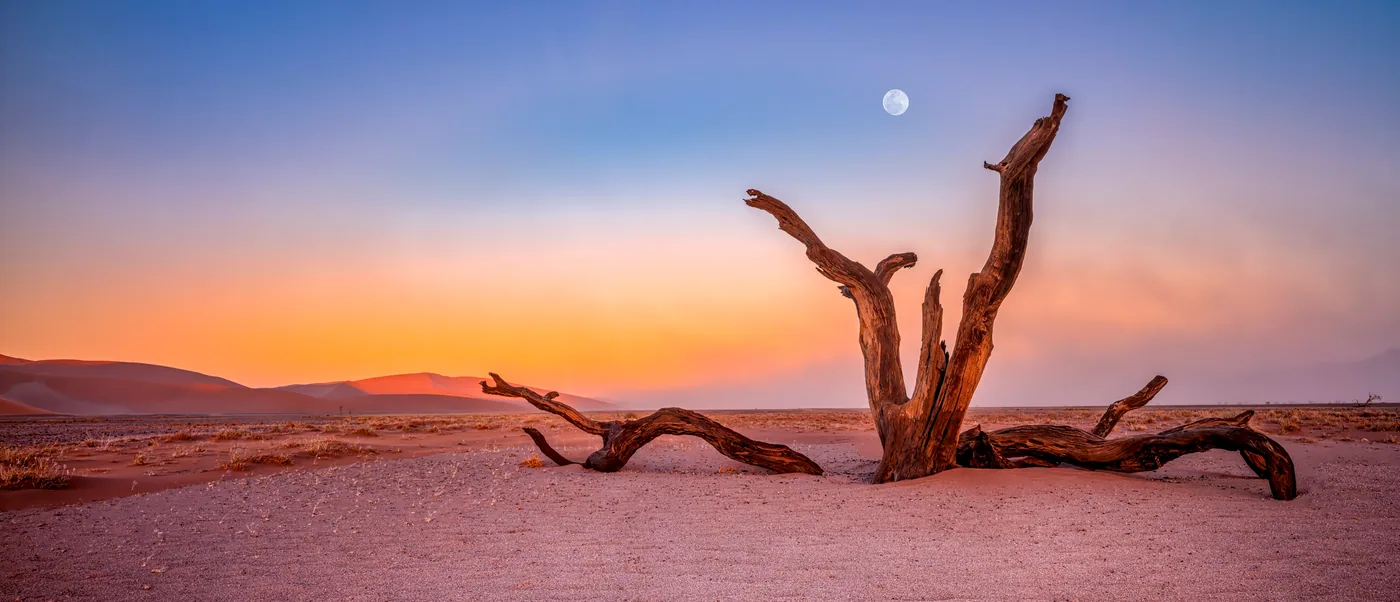
Namibia's desert landscape photography offers some of the world's most dramatic and unforgiving terrain. The Namib Desert, stretching across the entire width of the country, offers scenes of raw beauty: towering dunes, ghost towns swallowed by sand, and ancient trees standing alone against infinite sky. If you're drawn to desert landscape photography, Namibia rewards patience, early mornings, and a deep respect for the elements.
We've returned to these locations multiple times over the years, and each visit teaches us something new about light, timing, and the craft of capturing what makes these places feel almost otherworldly. Here's what we've learned.
Deadvlei and Sossusvlei: Capturing the Iconic White Pan
The white clay pan at Deadvlei, ringed by 300-meter dunes and studded with blackened camel thorn trees, is perhaps Namibia's most photographed location. The contrast is stunning: brilliant white clay, charred wood, rust-colored sand, and sky. But light makes or breaks the shot.
The magic happens before sunrise and in the first 90 minutes after. As the sun rises, it illuminates the pan floor while the surrounding dunes are still in shadow. Once the sun clears the eastern dune ridge, harsh light floods the entire scene and the visual drama flattens. We arrive in darkness, scout positions by headlamp, and are ready to shoot as the first light touches the pan's edge.
Composition matters here. Rather than standing at the pan's rim trying to capture everything, move around. Look for foreground interest: a single dead tree, the texture of cracked clay, a dune shadow cutting across the white. Frame the trees against the deep blue pre-dawn sky, or wait for that golden moment when warm light catches the dune slopes behind the trees. The strongest images isolate and emphasize rather than trying to show the whole landscape.
Learn more about the power of this location in our essay on the ghost trees of Deadvlei.
Kolmanskop: Ghost Town Light and Shadow
The abandoned diamond mining town of Kolmanskop, near Lüderitz, offers a different kind of desert photography challenge. Rooms fill with fine sand drifting through windows and broken walls. Light shafts cut through dusty interiors. The visual richness is immense, but so is the contrast problem.
When you shoot into a sand-filled room from a bright exterior, your camera's meter becomes confused. The outside is blown out or the interior is crushed to black. We solve this by working with the light rather than against it. Shoot into windows to capture the light beams and silhouettes. Position yourself so the sun rakes across the sand surface, revealing its texture. Embrace the shadows: sometimes a room's interior should be nearly opaque, with just a hint of detail. That restraint creates mood.
Ghost towns demand a slower pace. Spend time in each space. Watch how light moves across a wall as clouds pass. Notice the geometry: doorways leading to doorways, corridors framing distant dunes. The best frames often emerge when you slow down and simply observe. Walk through the same abandoned rooms in our essay on Kolmanskop, Namibia's diamond ghost town
Quiver Tree Forest: Ancient Sentinels at Dawn and Dusk
Near Keetmanshoop, the Quiver Tree Forest (Aloe dichotoma) offers a completely different desert photography subject. These unusual trees, with their pale branches and sparse foliage, stand like sculptural forms against the sky. They thrive in this harsh environment and have done so for centuries.
Shoot at the edges of the day: early dawn or late dusk when the sky deepens to indigo or purple. Position the trees as silhouettes or semi-silhouettes against this colored sky rather than trying to illuminate them with sun. A single tree isolated on a slight rise, framed against a moody twilight sky, becomes something timeless and almost spiritual. The aridity is part of the story. Explore this timeless landscape in our reflection on quiver trees at dusk, Namibia's timeless sentinels.
The Namib Sand Sea: Scale, Timing, and Technique
The great dune fields of the Namib present their own demands. Dunes are monumental, and conveying their scale in a two-dimensional image requires strategy.
Arrive in darkness. Position yourself on a dune ridge and watch the first light reveal the landscape. The low angle of early sun casts shadows that accentuate every ridge and ripple. Shadows give scale. A human figure standing on a dune slope, shot from far enough away, provides immediate sense of the dune's size. Include foreground detail: the texture of sand, a small plant, a stone. Shoot across the grain of the dunes rather than straight up the face.
The sand itself is your enemy and your friend. Fine Saharan-grade sand penetrates everything. Protect your gear:
- Use a sturdy camera bag with sealed compartments
- Carry a rocket blower to clear sand from lenses and sensor
- Change lenses only in shelter, never in open wind
- Store memory cards and batteries in sealed bags
- Bring a UV or clear filter on each lens to sacrifice rather than coat the glass
- Pack microfiber cloths and a cleaning kit, especially a sensor cleaning kit
Heat is another factor. Shade is nonexistent in the open desert. Start early, rest during midday hours, and resume in late afternoon. Drink far more water than you think necessary. Electronics overheat, battery life plummets, and thermal haze distorts images shot near midday. Work smart and take breaks.
Night Sky Photography in Namibia
If the opportunity presents itself, Namibia's night sky deserves attention. The country has minimal light pollution in most regions. The Milky Way rises with stunning clarity. Compose with a landmark in the foreground, even if barely visible: a tree, a rock formation, a dune. Use a wide aperture lens and a sturdy tripod. A 20-25 second exposure at ISO 3200-6400 on a full-frame camera with a 14-24mm f/2.8 lens will capture the core of the galaxy with foreground visible. If you're shooting medium format, be prepared for a more challenging exercise. The emotional impact of landscape photography deepens when you show both the small human presence and the vast cosmic context.
Bringing It Home
When we photograph the Namib's ancient dunes and ghost towns, we're not just documenting landscape. We're reaching toward something elemental and timeless. That same sense of reverence belongs on your wall.
A large-format print of desert landscape pulls you into the moment we experienced. The color, the light, the almost spiritual emptiness of Deadvlei at dawn, or the haunting geometry of Kolmanskop's rooms: these images remind you daily of beauty existing beyond the ordinary. Displayed in a home office, a living room, or a corporate space, they shift the mood of the room and the day. Fine art photography of these extraordinary places isn't decoration. It's an anchor. It's a daily invitation to step through the threshold and feel what lies on the other side of the ordinary.
When you're ready to explore dramatic desert landscapes and the craft behind them, visit Hammond Raffetto Art's full portfolio by clicking the link below.