

The Difference Between Empty and Minimal
There is a crucial distinction that we have learned through years of working in the field and at the processing desk: a sparse landscape is not the same thing as a minimalist photograph. A place that happens to be empty is not the same thing as a photograph that has been deliberately reduced to its essentials.
When we first started exploring minimalism in photography, we thought we were simply chasing emptiness. We'd search for wide vistas with nothing in them, expecting the absence of detail to do the work for us. It didn't. What we learned instead is that minimalism is a compositional decision we make, not a condition we find waiting for us. It is an active choice to remove, to exclude, to discipline the frame so that every element that remains has earned its place.
Minimalism requires intentionality. It requires us to look at a scene and ask not what we can fit into the frame, but what we can leave out of it. That question is harder than it sounds, because the instinct in the field is almost always to fill the frame with more. More detail, more interest, more proof that there is something worth photographing.
What Negative Space Actually Does
Negative space is often misunderstood as the absence of something. In practice, it is the presence of discipline. Negative space gives a subject room to assert itself rather than compete for attention. It forces the viewer's eye to stay with that subject instead of wandering off to fill in the empty parts of the frame.
Consider what happens when you place a single element in a vast field of emptiness. The eye has nowhere else to go. There is no competing focal point, no secondary interest, no escape route. The viewer is held in place, made to look longer at what you have chosen to show them. This is not passivity. This is control.
We have found that working with large-format imagery gives us the freedom to pursue this more aggressively. More resolution should, in theory, invite more detail and encourage us to include more. In practice, it does the opposite. The certainty that our files can absorb the loss of information allows us to crop harder, remove more, and strip a scene down further than we ever could have on film. We are not documenting. We are reducing.
Isolated Subjects: The Power of Standing Alone
Some of our most considered work centers on a single subject, alone in the frame. A lone tree. A single human figure. One line drawn across still water. Each functions as a subject specifically because it stands alone, with nothing else in the frame to divide the viewer's attention.
When we encounter a scene with an isolated subject, the temptation is always there to include more. A second tree. An interesting rock formation. A passing cloud. We have stood in the field and felt the pull to add something, anything, to broaden the appeal or deepen the complexity. Resisting that addition is often the harder discipline than composing the shot in the first place.
We've captured the smallest of ferns at the base of a coastal redwood, not for the fern, but for the tree that is revealed.. We have framed a lone tree standing in Lake Wanaka where the water becomes a frame within a frame, and the mountain a backdrop that earns no attention. In each case, the power of the image comes from what we did not include, not from what we did.
When we add a single element to a frame that might otherwise feel empty, that element must transform the entire composition. It must be the one piece that makes the rest legible. It must justify its presence through necessity, not decoration.
The Discipline of Knowing When to Stop
One of the hardest lessons in minimalist work is recognizing when a composition is complete. We return to promising locations across days or seasons, layering surprise and delight with familiarity. This return teaches us something deeper than the surface of a place. It teaches us patience.
We have found ourselves standing before a landscape that could easily accommodate another element. The sky over Lake Wakatipu doubled in its surface, two landscapes for the price of one, and we made the restraint to stop there, adding nothing further. We could have included a boat, a figure, a dramatic cloud. We did not, because the composition did not require it. The refusal to add more is the decision that defines it.
Patience is the real subject underneath all of this. Minimalism is very often not about finding an empty scene but about waiting for the clutter to leave it. A hiker crosses the frame, and we wait. A boat enters the water, and we wait. We hold the camera until the scene returns to what we came to photograph.
Restraint in the Digital Darkroom
Composition decisions are only half the work. Processing choices either serve or betray minimalist intent. Restraint is the operative word in the digital darkroom just as it is in the field, and a heavy processing hand can undo what a spare composition worked to achieve.
We have learned to ask ourselves the same question in post-production that we ask in the field: what can we remove? Can we lighten the shadows without adding information? Can we reduce contrast without flattening the image? Can we leave the file alone and trust that the composition is doing its work?
This is where many photographers abandon minimalism without realizing it. They compose with restraint and then layer their images with texture, clarity, and saturation until the original intention is buried. The digital darkroom is another place where the instinct is to add, to enhance, to push. The discipline of minimalism requires that we resist this.
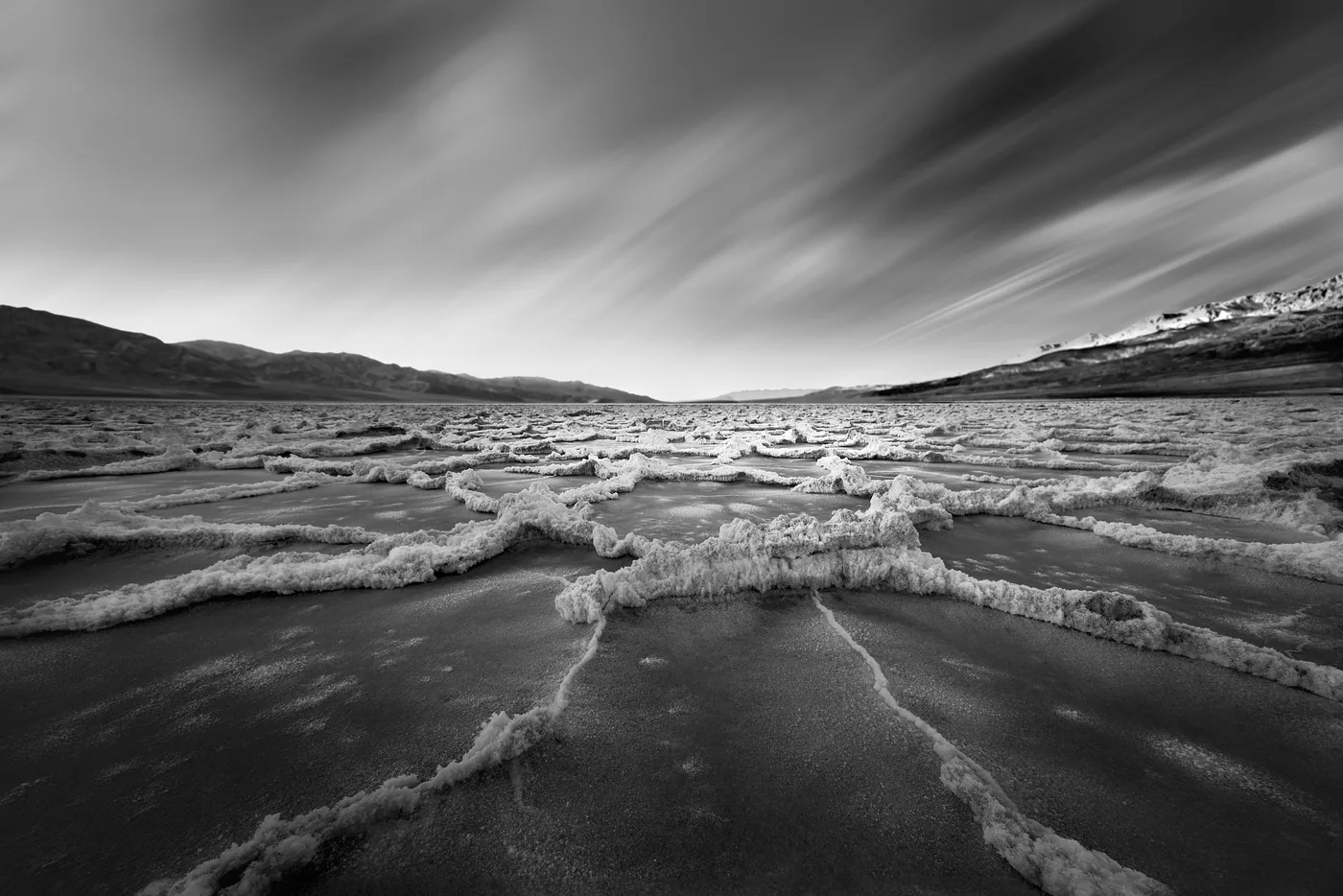
Where places seem to offer minimalism by default, like Badwater Basin where the salt flat removes everything except light, distance, and the decision about where to stand, the processing work becomes even more critical. The location may be spare, but the photograph still demands restraint. Still water, salt, and sky can be rendered a dozen different ways. The choice to keep them quiet is a choice.
Why Less Asks More of the Photographer
We practice subtraction because addition is the default and the easy path. It is easier to include more than to trust that less will work. A photograph with minimal elements lives or dies on the strength of those elements and the spaces between them. There is nowhere to hide.
For this reason, minimalist photography takes years to trust. You must learn to believe that the viewer will stay with your image even when you have given them little to look at beyond the essential. You must understand that a spare composition is not incomplete or timid. It is deliberate. It is a statement about what matters.
Publications devoted to quiet, considered seeing, like LensWork, have long recognized that some of the most powerful photographs are the ones that ask the viewer to slow down and look harder rather than faster. The work that endures is often the work that says the least but means the most.
Every photograph in Hammond Raffetto Art's body of work that pursues minimalism is proof that less asks more of the person making it. The restraint is visible in the final frame. The discipline shows.
The Path Forward
If you are drawn to minimalist landscape photography, the work begins not in finding empty places but in learning to see them differently. A valley floor is not minimal until you decide to photograph only its line. A lake is not minimal until you decide that the reflection alone deserves the frame. The landscape does not teach you minimalism. You teach the landscape what minimalism means.
We invite you to experience this discipline in the work we have made. Every image in our portfolio began as light on a subject, captured in real conditions, across real moments. Some of our most considered pieces required returning to a location across seasons before settling on a composition. The restraint you see is not luck. It is patience, discipline, and the decision to exclude far more than we ever show.