

Maui offers some of Hawaii's most striking landscapes for fine art photography. Whether you're drawn to powerful waterfalls, pristine beaches, or the raw drama of volcanic terrain, the island rewards photographers who take time to explore and return to locations across different seasons and light conditions. When I lived on Oahu, I visited Maui several times. I bicycled the slopes of Haleakala, had breakfast and later beers at little roadside bodegas, and generally took some awful pictures. When Mary and I finally got there together, I resolved to change that last outcome.
Planning Your Maui Photography
The key to capturing compelling Maui landscape photography is understanding how light moves across the island. Maui's geography creates dramatic contrasts: the windward side receives regular rainfall that feeds waterfalls and keeps valleys emerald green, while the leeward coast offers clear, golden light and calm waters. Each side tells a different visual story.
Before you head out, invest time researching access to specific locations. Some of Maui's most beautiful areas require patience and persistence to reach. The rewards, however, are images that feel earned and authentic. This approach to place-based photography mirrors the philosophy behind fine art work: returning to a scene across different times of day and seasons to layer meaning and discover new compositions.
Road to Hana and Waterfall Country
The road to Hana is more than a scenic drive; it's a pilgrimage through some of Maui's most photogenic terrain. The winding journey itself offers countless compositions. Pull-outs reveal misty valleys, dense tropical forests, and streams that seem to appear from nowhere.
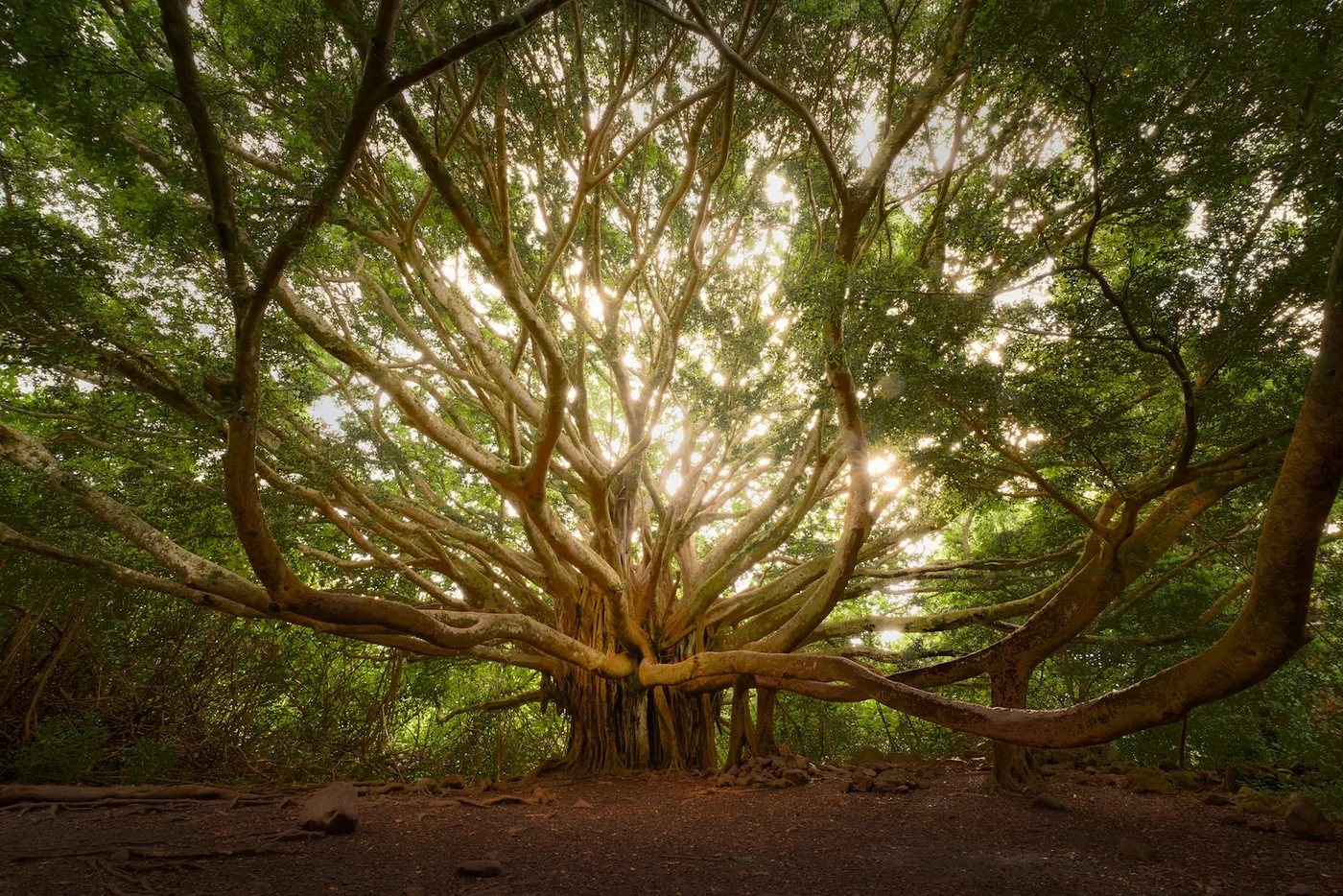
Waterfalls punctuate the drive, but the best—on the Pipiwai trail, including Makahiku Falls, a beautiful horsetail fall, and Waimoku Falls, which drops into an emerald pool surrounded by black basalt cliffs—require you to get out of your car and take a moderate hike; it's well worth it. Along the way, make sure to check out the stunning banyan tree (pictured above) on the trail.
At the waterfalls, the challenge is both light and context: these two falls are very different, as are their surroundings. The water speed, points of impact, surrounding vegetation, and the sun's transit all combine to create a significant, and worthwhile, interpretive challenge. The gorges and forest can feel quite dark even on sunny days. Early morning often yields better conditions, and patience allows time for clouds to shift and reveal subtle illumination. Capturing the texture of water, mist, and stone requires both technical skill and an understanding of how light behaves in enclosed spaces. Conversely, midday light can be flat and surprisingly uninspiring in this beautiful place. At these (or any) waterfalls, pay attention to where the light falls in relation to the water and its surrounding rocks and vegetation. That's where your image will be found.
The Road to Hana itself has become iconic, and rightfully so. Bamboo groves create natural corridors of green and shadow. Stream crossings offer reflective surfaces. If you can visit during the wetter months, the landscape feels alive in a way that invites contemplation.
Hidden Beaches and Coastal Drama
Maui's coastline ranges from the tourist-accessible to the genuinely remote. At Wai'ānapanapa State Park near Hana, a black sand beach meets volcanic cliffs — one of the island's most visually striking coastal locations, worth the early morning drive before crowds arrive. Further along the Hana coast, the lava shoreline becomes something entirely different: rough volcanic rock dropping to surging Pacific swells, a fisherman balanced above the water, golden light flooding the sky and clouds, silhouetting the scene. The black lava coast at Hana is among the most dramatic coastal environments in the Hawaiian Islands.
Coastal photography on Maui works best when you embrace the island's moody days alongside the obvious clear ones. Storm clouds, mist, and dramatic light breaking through overcast skies often produce the most compelling images. The contrast between foreground detail and distant drama creates visual depth and emotional resonance.
Maui's north shore, away from the resort corridors of Ka'anapali and Wailea, and opposite from the Road to Hana, holds some of the island's most challenging and rewarding locations. The Olivine Pools — a series of turquoise tide pools carved into black volcanic rock near the Nakalele Blowhole — are among the most visually striking. We arrived there pre-dawn, drawn by the combination of colored water, volcanic geometry, and the Mushroom Rock formation nearby. What we also found was an object lesson in ocean awareness. The Pacific along this stretch does not announce itself. Waves arrive with very little warning from a direction you may not be watching. Photograph here with one eye always on the water, and never in conditions that feel uncertain. The images are worth the effort. But do not take your equipment or your life for granted.
Volcanic Landscapes and High Elevation
Maui's two major volcanoes, Haleakala and the West Maui volcano, create landscapes that feel genuinely otherworldly. Haleakala's summit sits above the clouds, offering perspectives that seem to transcend the ordinary. The crater itself resembles terrain from another planet: red earth, sparse vegetation, and light that changes minute by minute as weather systems move through.
Be aware that visiting Haleakala for sunrise now requires reservations, and they can be very difficult to get. But during the rest of the day, and even late at night, no reservations are required. It's definitely worth a drive up during the day for scouting sunrise and for exploring the other-worldly landscape. When you scout, use software like TPE or PhotoPills to understand how and where the sun, moon, and Milky Way move across the crater and the landscape. Do not ignore the crater itself; its texture and detail reward close examination. Try to envision what your sunrise image will encompass. Frame it, choose your focal points. Do you want a full-scale panorama? Do you have the lens to encompass that? Do you like to shoot and stitch a panorama? Horizontal or vertical? Test your composition for the number of "slices" you'll need to take. Even with the high dynamic range of modern sensors, exposure bracketing is prudent, but it also takes extra time, especially if you are taking vertical slices. As you shoot the sun will be moving quickly. Assess which parts of the crater you want to be sure to be in the brightest light, and move from the opposite direction. Generally, during a sunrise stitching panorama, you move (shift or rotate your tripod head) from most light (where the sun is) toward the least light to balance the exposure. But here, you might want to slip that rule, depending on much light you want to see in the crater and where you want the sun to be in your image. The amount of high clouds, if any, will also affect this assessment.
If you're drawn to Maui beach photography that captures water and sky, the high elevation areas create different visual context. The contrast between volcanic rock and the distant ocean below produces compositions with real drama and scale. Many photographers overlook these areas, focusing instead on sea-level locations, but the reward for exploration is unique imagery. That's especially true with early morning and late afternoon lateral light.
Understanding Light and Composition
Maui photography, like all fine art landscape work, hinges on seeing light rather than simply visiting locations. The island offers abundant subjects, but your images will transcend the ordinary when you understand how light reveals form.
Consider these approaches:
- Time of day: Early morning and late afternoon offer warm, directional light. Midday sun can feel harsh, but it reveals dramatic shadow patterns in canyons and valleys.
- Weather systems: Rain clouds move quickly. Rather than wait for perfect blue skies, work with the moody light that clouds create.
- Return visits: Familiarity with a place allows composition to deepen. What seems obvious on a first visit often reveals subtler possibilities on the second and third.
- Foreground and depth: Strong compositions use elements at your feet to create visual passage into distant landscape.
Respecting the Place
Maui's locations carry cultural significance and ecological sensitivity. Photography is a privilege, not an entitlement. Leave no trace of your presence. Respect access restrictions. If a location feels fragile or crowded, move on to find quieter compositions elsewhere.
This respect for place reflects the broader philosophy of fine art photography: we are not here to extract or consume, but to witness and honor what we encounter. When you photograph with reverence for the landscape, your images carry that intention. Viewers can feel it.
Bringing Maui Home
The goal of Maui landscape photography is not just to save a beautiful memory, but to translate the feeling of a place into something that lives on your wall or workspace. A great photograph of Maui's cliffs, waterfalls, or beaches becomes a daily reminder of the grandeur you witnessed. It's one thing to gaze in wonder at everything around you; it's quite another to look through the viewfinder—how does that image make you feel?
Start with the locations outlined here, but remain open to the unexpected. Some of your most compelling images may come from places you stumble upon, where light and landscape align in ways you didn't anticipate. Photography on Maui teaches patience, observation, and the value of returning to a place across seasons and moods. That discipline produces work worth living with.