

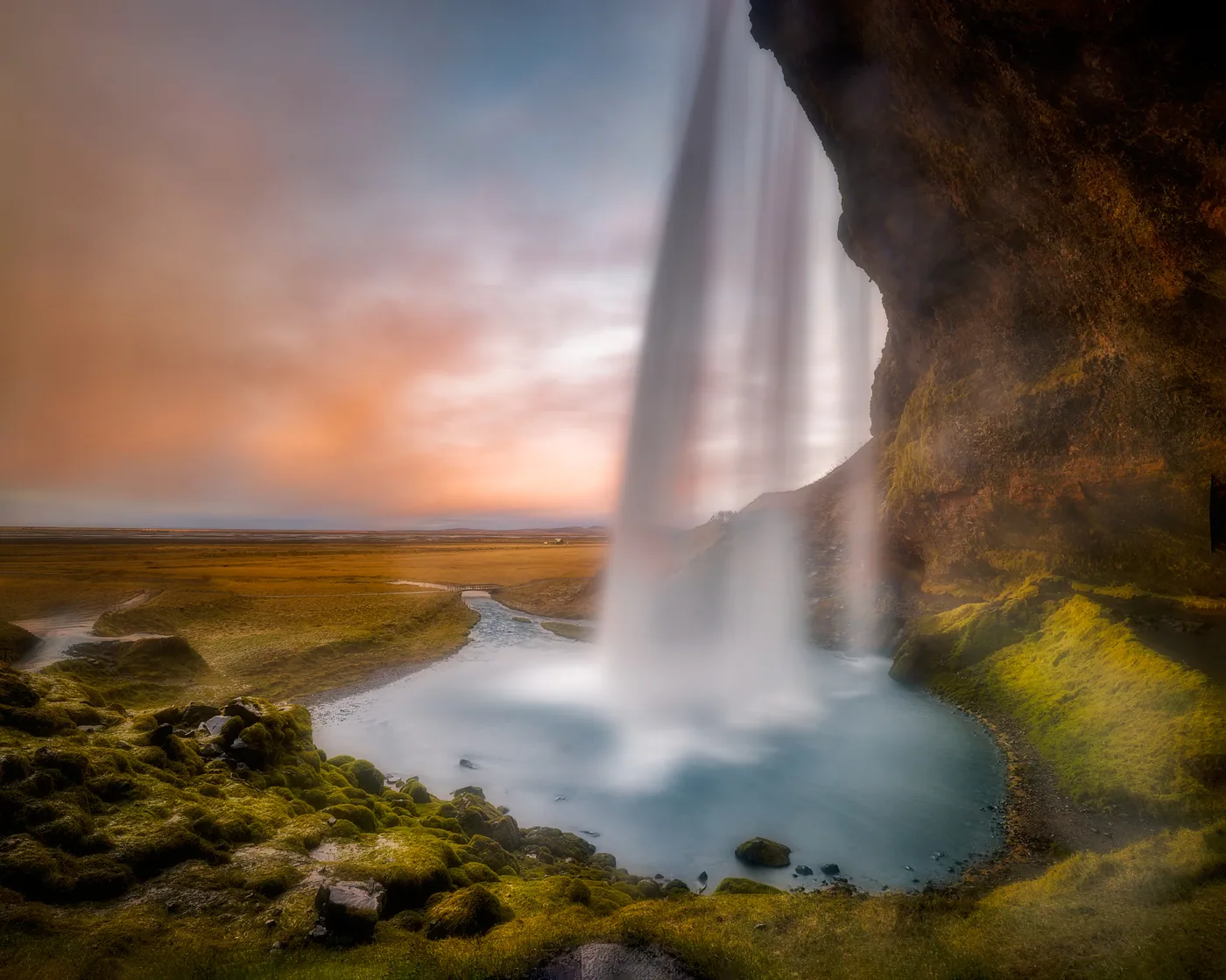
Iceland's waterfalls are among the most photogenic natural features on Earth. Whether you're drawn to the massive power of a cascade or the delicate mist rising from a plunge pool, these icy landscapes offer endless opportunities for stunning imagery. Long exposure waterfall photography has become a hallmark of fine art landscape work, and Iceland provides the perfect stage to master this technique.
The country's unique geology, abundant water, and dramatic light create conditions that reward both technical skill and creative vision. In this guide, we'll explore practical approaches to capturing Iceland's waterfalls and share insights into the locations that have inspired photographers for decades.
Understanding Long Exposure for Flowing Water
Long exposure waterfall photography transforms turbulent water into ethereal, silk-like flows. The technique works by holding the camera's shutter open for several seconds or longer, allowing moving water to blur smoothly across the frame while stationary elements remain sharp.
This approach reveals something the human eye cannot see in a single glance: the passage of time itself frozen into a visual form. A two-second exposure captures the arc of water in a way that feels dreamlike, almost painterly. The result is rarely the "frozen moment" of conventional photography. Instead, it becomes a meditation on motion, flow, and the invisible beauty hiding in plain sight.
The beauty of this method is that it works equally well whether you're shooting a powerful cascade or a gentle stream. The constraint is light and the speed of the water. Long exposures require either very dim conditions, dense filters, or both, which means timing matters . Early morning and late evening often provide ideal conditions without the need for heavy filtration. As to water velocity, no matter the light, the speed of the water has to be considered. Fast-moving water will blur gently at even modest, hand-held shutter speeds, especially with today's IBIS and OIS systems.
But note: this is not a one-size-fits-all technique. There are times when you don't want to blur the water so much, when the energy of splashing, flowing water is better portrayed by a higher shutter speed. You also don't want to blur the water so much that you lose all definition of the surrounding features such as boulders, plants, etc.
But no matter how sophisticated your image stabilization, I cannot recommend enough the use of a tripod. But before the tripod comes the understanding of the subject:
- Before you even set up your tripod, walk around the fall [good advice for any subject], consider where your light is coming from and where it lands;
- Use your phone to take test shots of your intended composition(s); shoot ion Live View so you can see what your phone's software does with the long-exposure setting. This will help inform your assessment of water speed and how slow is too slow for your shutter;
- Make sure you have any necessary filtration to achieve any necessary light reduction for your intended shutter speed;
- Protect your camera and lens from mist [a cheap shower cap is great for this], and have a microfiber cloth handy to keep wiping everything down in between shots.
- Consider multiple exposures at different shutter speeds. You may not remember exactly how you gelt at the moment when you are back at your desk post-processing, but having different "interpretations" of the water will inform your mind, heart, and eye as to which rendition of water speed best conveys your memory of the place.
Best Times and Weather for Shooting
Iceland's daylight varies dramatically by season. In summer, the sun barely sets, offering nearly continuous golden light. In winter, you get only a few hours of daylight, but the quality can be extraordinary, especially in that for most of the day, it is horizontal. Neither season is wrong; they simply demand different approaches.
Rain and mist are gifts in Iceland. They add volume to waterfalls, soften the light, and create atmospheric depth. Many photographers plan their trips around the rainiest months, October through December and March through April. The extra water makes falls more visually striking, and the reduced daylight naturally supports longer exposures.
Morning light has a particular magic in Iceland. The low angle illuminates mist rising from plunge pools, and the cooler color temperature reinforces the sense of place. If you visit in summer, plan to shoot in the early hours or late evening when shadows lengthen and the landscape feels less harshly lit.
Composing Iceland's Iconic Falls
The most compelling waterfall photographs show more than just water. They show context: the moss-covered rocks surrounding the fall, the mist-shrouded landscape beyond, the passage from one elevation to another. This is where composition becomes art rather than documentation.
Look for foreground interest. A pool of water reflecting the sky, rocks with interesting texture, or moss and vegetation can anchor the lower third of your frame. Position your main fall to create movement through the image, often using the water's path as a visual guide that leads the viewer's eye.
Many photographers find that staying low and shooting upward gives waterfalls a more imposing presence. Others prefer stepping back to show the waterfall within its broader landscape context. The iconic Seljalandsfoss is a perfect example of this principle: the fall becomes more dramatic when you show not just the cascade but also the cliffs, the river below, and the distance beyond.
Symmetry and asymmetry both work. Centered compositions can feel formal and grounding. Off-center falls with strong foreground or background elements create dynamic tension.
Light and Atmosphere in Iceland's Landscape
Light in Iceland behaves differently than in many other places. The high latitude, the reflective water and ice, and the frequent cloud cover create a diffused, forgiving quality. Harsh shadows are less common. Instead, you often work with soft light that wraps around the landscape.
Mist rising from falling water is one of Iceland's most beautiful phenomena. This mist becomes visible material in your photograph, especially during cooler months. It catches light, adds volume, and creates a sense of mystery and scale. Rather than fighting against it, learn to compose with it. Let mist soften your background and create layers of depth.
Icelandic landscape photography often emphasizes cool tones and moody atmospheres. The blues of ice, the greens of moss, and the grays of stone and sky dominate the palette. Resist the urge to warm or saturate beyond what feels true to the place. The subtle beauty of Iceland often lies in restraint.
Essential Locations for Waterfall Photography
Iceland has countless waterfalls, but a few stand out for their photographic appeal and accessibility:
- Seljalandsfoss [pictured above]: A free-standing fall where you can walk behind the curtain of water. This unique position offers endless compositional possibilities. Be alert to the cavern height when framing the waterfall; it is very easy to cut off the arch if you are not careful.
- Skogafoss: A massive, powerful fall with a roaring presence. The scale here is difficult to overstate, and the mist rising on overcast days is often extraordinary.
- Gullfoss: A two-tiered fall that descends into a deep canyon. The sheer drop and the mist rising from the gorge create dramatic light and atmosphere.
- Dettifoss: One of Europe's most powerful falls, located in the north. The raw energy here demands respect and offers extraordinary visual intensity.
- Kirkjufellsfoss: Adjacent to Mt. Kirkjufell, a lovely mountain that resembles a church or hat, and was featured in Game of Thrones. The falls and the mountain are stunning.
- Goðafoss: Loosely translated as "waterfall of the gods," the horseshoe shaped canyon produces multiple falls.
Beyond these famous locations, Iceland's interior highlands hide dozens of lesser-known waterfalls. Research remote sites and plan to explore them early in your trip. The light and weather will guide which locations work best on any given day.
Planning Your Iceland Waterfall Trip
Prepare for Iceland's weather by layering. Mist and spray mean you will get wet, no matter how carefully you position yourself. Protect your equipment with weatherproof covers or dry bags.
Consider your timeline. A week allows you to visit the major falls and explore secondary sites. Two weeks gives you flexibility to chase weather and light, revisiting locations across different conditions. Many photographers return to promising locations across multiple days or seasons before settling on a final composition.
Stay patient and observant. The best light may last only minutes. The most compelling compositions often emerge after you've spent time with a place, let it become familiar, and then seen it transform under new conditions.
Iceland's waterfalls offer some of the finest opportunities for long exposure waterfall photography anywhere. Whether you're drawn to the technical challenge of capturing flowing water or the emotional response to these dramatic landscapes, the country rewards both preparation and intuition. Visit during conditions that suit your vision, compose with intention, and let the light and landscape teach you what they want to reveal. The waterfalls have been flowing for millennia. A patient photographer discovers that taking time to truly see them transforms what you capture into art.