

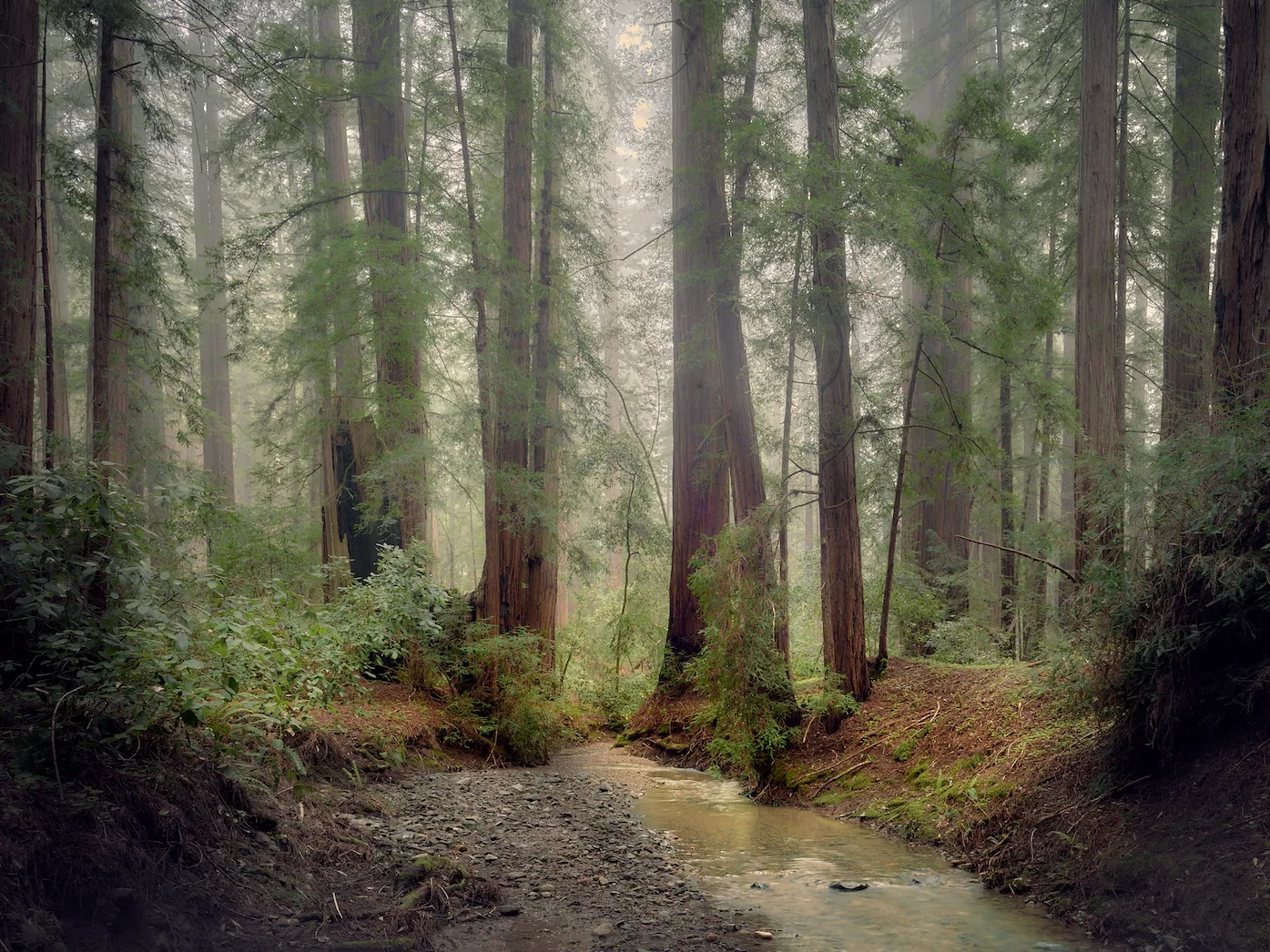
We tell people we do landscape photography, and they picture wide vistas, clean horizons, and the kind of light that announces itself from miles away. Then we take them into a redwood grove or a sequoia forest, and they understand: forest photography is some of the hardest technical work landscape photographers will attempt. There is no horizon line to anchor a composition. The dynamic range between canopy and forest floor is extreme, nearly impossible for a sensor to hold in a single exposure. The visual complexity of trunks, branches, undergrowth, and layered foliage fights the camera at every turn in a way that open landscapes simply do not. And yet, this is precisely why we keep going back.
The Technical Challenge of Forest Interiors
When we work in an open landscape, the light tells us what to do. A mesa at sunset has obvious geometry. A lake reflects the sky. Shadows fall in readable patterns. A forest does none of these things. Inside the canopy, geometry dissolves. Light becomes fragmented, localized, sometimes almost theatrical in the way it pools around specific trunks or patches of fern while the surrounding space remains in shadow.
This fragmentation is the core problem. We cannot show everything, and we cannot rely on a strong overall light direction to unify the frame. Instead, we have to learn to see forests as series of smaller compositions nested inside a larger space. A single patch of moss catching side-light becomes its own study. A stream moving through ferns and shadow becomes a corridor of its own logic. The camera sees differently than the eye does when surrounded by trees, and we have to train ourselves to compose for that difference rather than fight it.
The dynamic range inside a dense forest pushes modern sensors to their limits. The canopy above can be bright; the forest floor where we stand is often in deep shadow. A single exposure that retains detail in both typically does not exist. We work with long exposures and graduated neutral density filters. We bracket. We shoot in conditions most photographers would call "too dark to be working in the first place."
Light in Old-Growth Forest vs. Second-Growth
Not all forests are created equal, and light behaves very differently depending on the architecture of the trees themselves. An old-growth redwood or sequoia grove that has stood for a thousand years or more has an interior structure that a younger, denser forest will never develop. The ancient trees are spaced differently. Their massive trunks create vertical punctuation points instead of a monotonous texture. The canopy has gaps, real breaks where light reaches down to the understory and creates that sense of illuminated passage that draws us back again and again.
A second-growth forest, even a healthy one, is denser and more uniform. The trees are straighter and more tightly spaced. The canopy is a continuous roof. Light, when it filters through, tends to be diffuse and even rather than directional and sculptural. For certain kinds of forest work, diffuse light is exactly what we want. For the dramatic shaft-of-light imagery most of us associate with fine art forest photography, you need the architecture of age.
This is one reason we return to the same groves repeatedly. The photographers who do consistently strong work in a forest are not the ones chasing novelty. They are the ones who know where the light will fall on a given morning in November, or why March at six-thirty produces a particular quality of illumination, because they have been there dozens of times and watched the sun move through the same canopy gaps on different days and seasons. Familiarity is not the enemy of discovery in forests; it is the prerequisite for it.
Coastal Fog and the Redwood Requirement
Coastal redwood photographers often fight the fog in their early work. Overcast skies and drifting mist seem like obstacles, like the weather did not cooperate. This is the wrong way to see it. Fog is not an obstacle to work around in a coastal old-growth grove. It is a prerequisite for the images that actually succeed in that environment.
Think about what a cloudless day looks like inside a redwood forest. The sun beats down on the canopy, creating harsh, unreadable shadows and blown highlights. The forest interior, which depends on subtle gradations of light and shade, becomes a mess of contrast. But introduce coastal fog or overcast conditions, and everything changes. The light becomes even, directional without being harsh, and the trunks and ferns and undergrowth start to read as form instead of as a tangle of textures competing for attention.
This is why we prefer to work coastal groves during the overcast season. This is why Armstrong Redwoods, where the Latin title earns its meaning: lux in nemore, light in the grove, gives up its best images on mornings when most people would leave and come back when the weather clears. The moment morning light knifes through the canopy at Prairie Creek Redwoods, a window that closes in minutes, the entire composition hangs on whether we understood exactly where to stand and what lens to use before that light arrived. There is no such thing as being almost ready. Either we are ready when the light appears, or we miss it entirely and come back another morning.
The Scale Problem: Representing the Unrepresentable
A coastal redwood stands 280 feet tall and 30 feet across. A giant sequoia holds more volume than most buildings. How do you represent that inside a two-dimensional frame? This is not a small technical question. It is a fundamental compositional problem.
We have found that the answer usually involves one of two choices. Either we introduce a human figure for scale, which immediately reframes the image as "person dwarfed by tree" rather than "tree as subject," or we abandon the idea of showing the whole tree at all and instead photograph a section of trunk, a detail of bark and light, a grove as pattern rather than as individual giants.
Both approaches work. Both tell true things about old-growth forests. Neither solves the problem by trying to show the whole tree at once, because that choice typically produces an image that feels small and disappointing no matter how large we print it. The forest humbles the camera just as it humbles the person standing in it. Learning to compose with that humility built in is part of learning to see forests on their own terms.
Water, Long Exposure, and the Stillness Around It
Forest streams deserve their own conversation. When we render moving water smooth through long exposure, that soft blur sits inside a frame of absolute, photographic stillness. The ancient trunks do not move. The ferns do not move. The rocks do not move. The flowing water becomes the only element with visual motion, and that contrast creates a particular kind of visual poetry that depends on the immobility of everything surrounding it.
We use longer shutter speeds in forest streams than we might in more open water photography, precisely because the surrounding stillness is so pronounced and so powerful. The technique works because the forest itself is the anchoring, stable presence in the frame. The moving water becomes an accent rather than a distraction.
Returning to the Same Grove, Morning After Morning
We go back to the same groves because a forest never gives up its light on the first visit. The photographers who produce genuinely strong work in forests are the ones who have invested time in specific places. They know where the light falls at specific times of day and year. They know which morning conditions produce which qualities of illumination inside the canopy. They know when to return and when to stay home. The ecology and conservation history behind these groves is documented by Save the Redwoods League—an essential resource for understanding why what we are photographing is still there to photograph at all.
This approach runs counter to the cultural pull toward discovery and novelty. But it reflects something true about how forests actually work. The interior logic of a forest, the rules of light and dark and shadow and illumination, have to be learned on the forest's terms, not imposed from outside. They require presence. They require attention. They require the willingness to stand in the same patch of ferns for ten mornings before the light falls exactly right.
A burned sequoia or a fire-scarred redwood is not diminished by its damage. We have photographed a Humboldt Redwoods giant that fire could not put down, what the forest teaches about the difference between damage and defeat, and what that scar adds to an image goes beyond the light hitting the trunk. It is the visible history of a place that has endured, survived, continued growing. That history lives in the photograph.
The Work of Seeing Like a Forest
Forest photography stops being difficult when we stop treating it as scenery to be admired and start treating it as a space with its own rules that have to be learned. The light inside a forest is not a universal constant. It is local, specific, time-dependent, and conditional on season, weather, time of day, and the particular geometry of the canopy above.
We learn to see like a forest sees itself, which is to say we learn to notice the small passages of light, the subtle textures of bark and fern and shadow, the way a stream breaks the visual continuity of a grove and becomes its own element. We learn that being almost ready means we will miss the light, that returning to the same grove ten times produces better images than discovering ten new groves once, and that coastal fog is not something to endure but something to use.
The forests themselves are the real teachers. We are just the ones standing in the shade with cameras, trying to learn their language fast enough to catch the moment when light and form align.
If you want to understand what this work looks like in practice, visit Hammond Raffetto Art to see the portfolio of forest and redwood photography. These images are the product of returning, waiting, and learning to see the forest on its own terms.