

Yes, Yosemite is essential. Half Dome at dawn, El Capitan catching the last light of day, Bridalveil Fall in spring flood. We have stood in that valley countless times, and the scale never fails to move us. But Yosemite is where everyone arrives with a camera. It is the known quantity, the proven destination, the place where millions of photographs already exist.
California landscape photography, though, extends far beyond that granite cathedral. We have spent years exploring the state's less-traveled corridors, and what we have found is a California that offers dramatically different light, composition challenges, and visual rewards. This is where we want to take you.
The Coastal Redwoods: Light in Enclosure
The old-growth redwood forests of Northern California present a fundamentally different problem than open landscape photography. You are not working with distance and sky. You are working with enclosure, depth, and the behavior of light filtered through canopy so dense it blocks the sun entirely for much of the day.
Prairie Creek Redwoods State Park and Humboldt Redwoods State Park, particularly the Avenue of the Giants, are where we learned to see light differently. The challenge is not dramatic sky or distant peaks. It is the rare moment when morning light knifing through the old-growth canopy at Prairie Creek Redwoods State Park finds a patch of understory or creek, transforming mist and fern into luminescence.
Arrival time matters more here than almost anywhere else in California. The window when direct light reaches the forest floor is narrow and brief. Mist behaves differently depending on whether light is striking it from above or whether you are still in shadow. We shoot these scenes in early morning, when the canopy moisture is still high and the angle of the sun is low enough to penetrate the trees. By mid-morning, the quality of light has shifted entirely.
The compositional challenge is different too. You cannot rely on expansive vistas. Instead, you are composing with texture, translucence, and the layering of tree trunks at varying distances. A single shaft of light through the canopy becomes your subject, not the forest as a whole.
Sequoia and Kings Canyon: The Scale Problem
The Giant Sequoias present a paradox that most photographers encounter only once they arrive. These are the largest living things on Earth. Yet a single tree, photographed in isolation, often reads as small on a flat image. The eye has no reference for its actual size. You cannot step back far enough to fit one in the frame.
This is why the Generals Highway through Sequoia National Park, one of the most dramatic drive in the Sierra Nevada, becomes so important. Here, the sequoias exist in relationship to their landscape. Massive trees frame the road. Granite cliffs rise behind them. You can compose a scene that tells the viewer something about the environment these trees occupy, and in doing so, you communicate something about their scale.
We approach these scenes by looking for compositions that include multiple elements: the sequoia itself, the surrounding forest, the texture of the path or stream beneath, the sky above if it is visible. A mature giant sequoia next to a human figure conveys size, yes, but it is also obvious and lacks elegance. A sequoia rising behind smaller trees, with a road leading into shadow beneath it, tells a story about proportion and majesty without being literal.
The light in these high valleys is clearer than in the redwoods but still filtered by canopy. The best shooting happens early and late, when the sun angles through the trees. Midday produces flat, uninspiring images.
The Eastern Sierra: Contrast and Clarity
If the coastal forests teach you about the subtlety of light in enclosure, the Eastern Sierra teaches you the opposite: the clarity and harshness of high-desert light, and the visual power of extreme contrast.
The Alabama Hills near Lone Pine sit on the western edge of the Owens Valley, with the Sierra Nevada wall rising dramatically behind them. These bare, sculptural rock formations are composed of granite and diorite, worn into shapes that almost seem intentional. The contrast is visual and conceptual: the jumbled, chaotic foreground rocks against the clean, vertical thrust of the Sierra ridgeline.
The light here is different from anywhere else in California. At this elevation and in this desert, the air is so clear that distant mountains appear deceptively close. Shadows are deep and pure black. Highlights are bright white. There is very little midtone. This is not forgiving light, but it is powerful light.
We have found that the best work here comes from embracing that contrast rather than fighting it. Shoot the bare rock formations against the Sierra in morning or evening light, when the wall catches golden illumination and the foreground remains in shadow. The compositional strength comes from the interplay between textured chaos below and ordered majesty above. The road to Whitney Portal through the Alabama Hills — where the Sierra Nevada wall rises from the Owens Valley floor — makes the scale register in a way that arriving by any other route does not. The Sierra builds incrementally as you drive, and by the time you reach the portal itself, the proportion between desert floor and granite wall has settled into something you can feel in the frame.
For those willing to drive higher into the White Mountains, the Ancient Bristlecone Pine Forest offers a different kind of austere beauty. These are the oldest living organisms on the planet, gnarled and weathered into abstract forms. The light here is even clearer, even more surgical. The trees themselves become sculpture.
Joshua Tree: Compositional Patience
Joshua Tree National Park is uncomfortable. The light is harsh. The landscape is chaotic. There are few natural vistas that read as immediately beautiful. It is not a place you arrive and immediately understand compositionally.
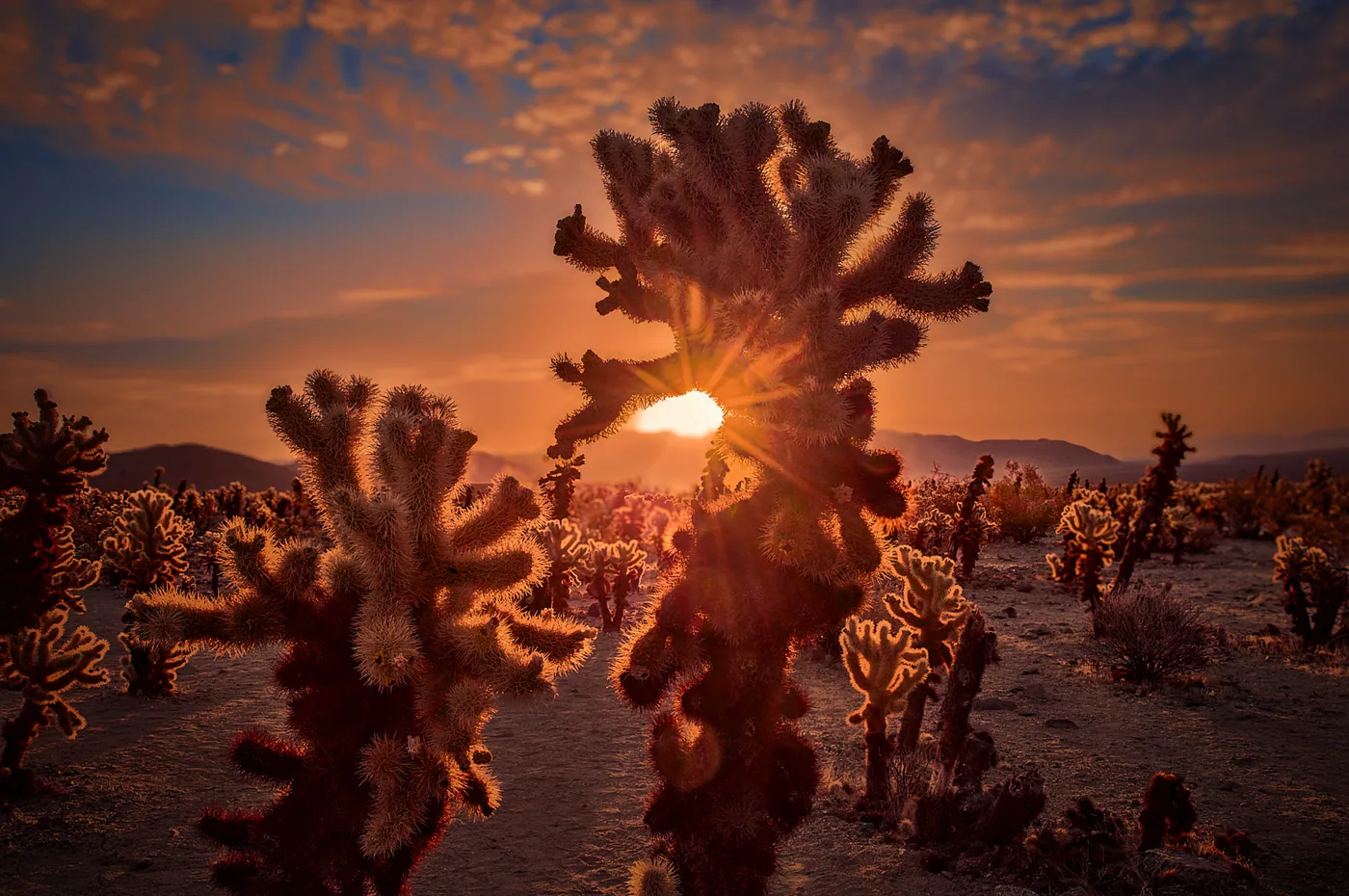
This is precisely why it is essential to photograph. The compositional challenges force you to think differently about form, line, and negative space. A single Joshua tree is a study in twisted geometry. The Cholla Garden presents a subject that seems almost hostile to framing. You cannot shoot here in autopilot. We have written at length about the cholla cactus at Joshua Tree National Park — where the Mojave Desert produces something that looks gentle and is not — because working that garden at first light, when the barbed spines go translucent against the sun, teaches a specific kind of compositional patience that applies everywhere else.
We have learned to slow down in Joshua Tree. You spend more time looking than shooting. You walk multiple angles on a single subject. You frame rocks and cacti and distant mountains in relationships that are not immediately obvious. The harsh midday light that would destroy a landscape photograph in other locations becomes useful here. It defines form without flattery.
The best light in Joshua Tree comes early and late, like everywhere else, but we have also found that the strange twilight hour just after sunset, when the sky holds a deep blue and the landscape below is still rimmed with warmth, offers compositional possibilities unlike anywhere else in California.
Logistics and Best Practices
These destinations require different approaches to trip planning and gear. Consider the following when preparing:
- Northern coastal redwoods see significant fog year-round; plan for moisture in your equipment and expect dramatic shifts in visibility
- The Sequoia/Kings Canyon corridor can have road closures in winter; the Generals Highway may be impassable November through April depending on snowfall
- The Eastern Sierra is accessible year-round, but winter brings snow at higher elevations; the Ancient Bristlecone Pine Forest and White Mountain road require good weather
- Joshua Tree's best shooting windows are October through April; summer heat and harsh midday light make productive work nearly impossible
- All of these locations benefit from extended time and multiple visits; return trips reveal what you missed in the first visit
For detailed trip planning, current conditions, and permit information, consult the National Park Service California resource page.
Making the Images Live at Home
These landscapes carry something of the places themselves. When you display fine art photography from California's hidden regions in your home or workspace, you are not simply hanging a picture on a wall. You are creating a daily reminder of those moments when we stand before something larger than ourselves.
A redwood forest print brings the weight of ancient growth into a room, the sense of enclosure and mystery. A Sequoia road composition speaks to journey and proportion. Eastern Sierra work carries the clarity and hardness of high altitude. Joshua Tree prints challenge viewers to find beauty in the unconventional.
California is vast, and Yosemite is only one chapter. The coastal redwoods, the Sierra Nevada corridors, the high desert, and the Mojave interior each offer distinct visual and technical challenges. If you are ready to move beyond the known destinations and explore what the state truly offers photographers willing to look beyond the obvious, these landscapes are waiting.