

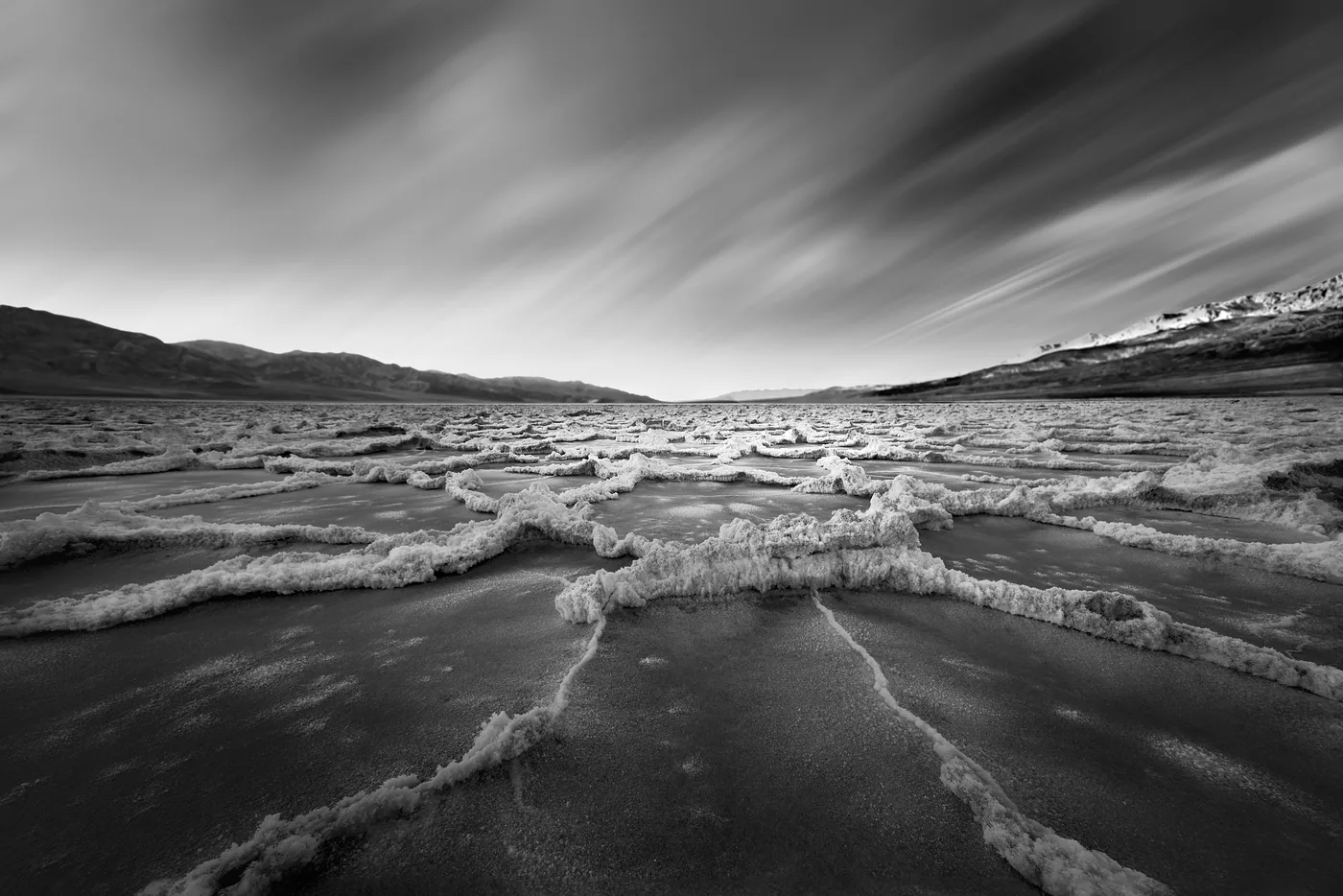
Black and white landscape photography strips away the distraction of color and forces you to see what really matters: light, shadow, texture, and composition. When you work in monochromatic tones, every element of your image must earn its place. Contrast becomes your primary tool. Texture becomes your storyteller. The result can be profoundly moving in ways color sometimes masks.
Hammond Raffetto Art's collection includes stunning examples of how black and white landscape photography reveals the hidden architecture of wild places. From the mineral-white expanses of Death Valley to the sculptural rock formations of Yosemite, monochromatic work invites viewers to see these landscapes not as postcards but as meditations on light and form.
Understanding Tonal Range and Contrast
The foundation of compelling black and white landscape photography is tonal contrast. In color photography, a bright red flower catches your eye. In monochrome, only light levels matter. This means your blacks need to be truly black, your whites truly white, and your midtones should transition smoothly between them.
When you're composing a landscape, look for scenes with natural separation between light and shadow. Backlit subjects create drama. A sunlit cliff against a dark sky, a bright water surface against shadowed forest, or a pale salt flat against distant mountains all deliver the contrast your monochromatic image needs to feel alive.
Hammond Raffetto Art's Death Valley series demonstrates this principle powerfully. The brilliant whites of mineral deposits contrast sharply with deep shadows in canyon recesses. There is no ambiguity about where light falls and where it doesn't. This clarity is what makes black and white landscape photography so visually compelling.
Emphasizing Texture and Detail
Color distracts from texture. Remove it, and suddenly every ripple in sand, every crack in stone, every leaf and branch becomes visible. B&W nature photography excels at revealing the tactile qualities of a landscape.
Seek out surfaces that show character: weathered bark, wind-carved rocks, flowing water, intricate lichen patterns. Position your light to rake across these textures, creating shadows that emphasize dimension. Side-lit and backlit scenarios work especially well. Early morning and late afternoon sun, when the sun sits low on the horizon, provides the kind of directional light that makes texture sing in black and white.
Yosemite's granite walls, Namibia's rock formations, and patterns in Death Valley's mineral deposits in Badwater Basin [the image above] all offer rich textural opportunity. The key is patience. Return to a location across different times of day and seasons. You'll discover how light reveals different qualities of the same landscape.
Composition Without Color
Color can carry weak composition. A vivid sunset might distract you from a poorly balanced frame. In black and white landscape photography, composition must be airtight. Every line, shape, and value relationship has to work together.
Consider these compositional tools:
- Leading lines guide the viewer's eye into and through the image. A road, river, or ridge can create a powerful sense of movement or passage.
- Foreground, middle ground, and background help build depth. Strong foreground detail grounds the viewer while the background provides context and scale.
- Geometric shapes become abstract and powerful when stripped of color. Circles, triangles, and rectangles create visual interest.
- Negative space matters more than ever. Don't fill every corner with detail. Let emptiness speak.
Hammond Raffetto Art's approach to landscape composition emphasizes threshold and passage. You'll see gates, arches, corridors of light, and openings that draw you forward. These compositions work equally well in monochrome because the structural elements are strong enough to carry the entire image without color support.
Mastering the Technical Side
Black and white landscape photography benefits from deliberate exposure and post-processing. Shoot for the highlights when possible. In digital capture, overexposed highlights lose detail permanently, but underexposed shadows can recover information in processing.
Consider working with the RAW format. It gives you much more latitude in the darkroom (whether digital or chemical) to develop the tonal range you envisioned. Slight underexposure in the field often yields richer, more printable files after processing.
Pay attention to your light meter. Reflective surfaces like water, snow, and sand will fool a standard meter into underexposure. Knowing your landscape and how light behaves there helps you meter intentionally rather than reactively.
Building Mood Through Value and Atmosphere
Tone creates mood in ways color cannot. High-key images, where most tones cluster in the light range, feel ethereal and peaceful. Low-key images, dominated by dark tones, feel dramatic and contemplative. Mid-tone images feel balanced and calm.
Fog, mist, and atmospheric haze are your allies in black and white. They compress tonal range and create mood instantly. A misty morning in a canyon reads differently in monochrome than in color. The mist becomes a tonal presence, a character in the image rather than merely an atmospheric effect.
Death Valley and Yosemite offer wildly different moods. Death Valley's clarity and extreme contrast suit bold, high-contrast black and white treatment. Yosemite's often misty, forested terrain benefits from softer, more nuanced tonal ranges that landscape photography in the slow lane encourages you to discover through patient observation.
Seeing in Black and White
This was the most difficult aspect of monochrome imagery for me. Even with the ability of the Phase and the Leica and other cameras to present a B&W image in the finder. The real skill isn't technical. It's learning to see in monochrome before you ever press the shutter. This takes practice. Look at landscapes and imagine them without color. Which scenes would be strongest? Where would light and shadow create visual power? Develop this habit and your black and white landscape photography will leap forward.
Study the masters of monochromatic landscape work. Notice how they use contrast, how they handle atmosphere, how their compositions guide your eye. Notice, too, how the same landscape can yield wildly different images depending on light and season.
Black and white landscape photography is ultimately about honesty. It removes the emotional shortcut of color and asks your image to communicate through form, light, and contrast alone. This constraint breeds creativity. Embrace it, and you'll discover that monochromatic work can be just as moving, just as beautiful, and often more memorable than anything color alone could achieve. The landscapes themselves will show you the way forward.