

The United States is home to some of the most photographically compelling landscapes on the planet. From ancient forests draped in cathedral light to granite walls that catch the last glow of a setting sun, the national parks offer an almost overwhelming wealth of visual possibility. Whether you are a seasoned collector searching for the next piece to anchor a room, or simply someone who loves the feeling that a great landscape image can produce, knowing which parks reward the most attention is a good place to start. As a caveat, we should note that we have barely scratched the surface of America's parks, and there are people who have been to many more. But this is some of what we have learned and can share.
Yosemite Valley: Where Light Becomes Architecture
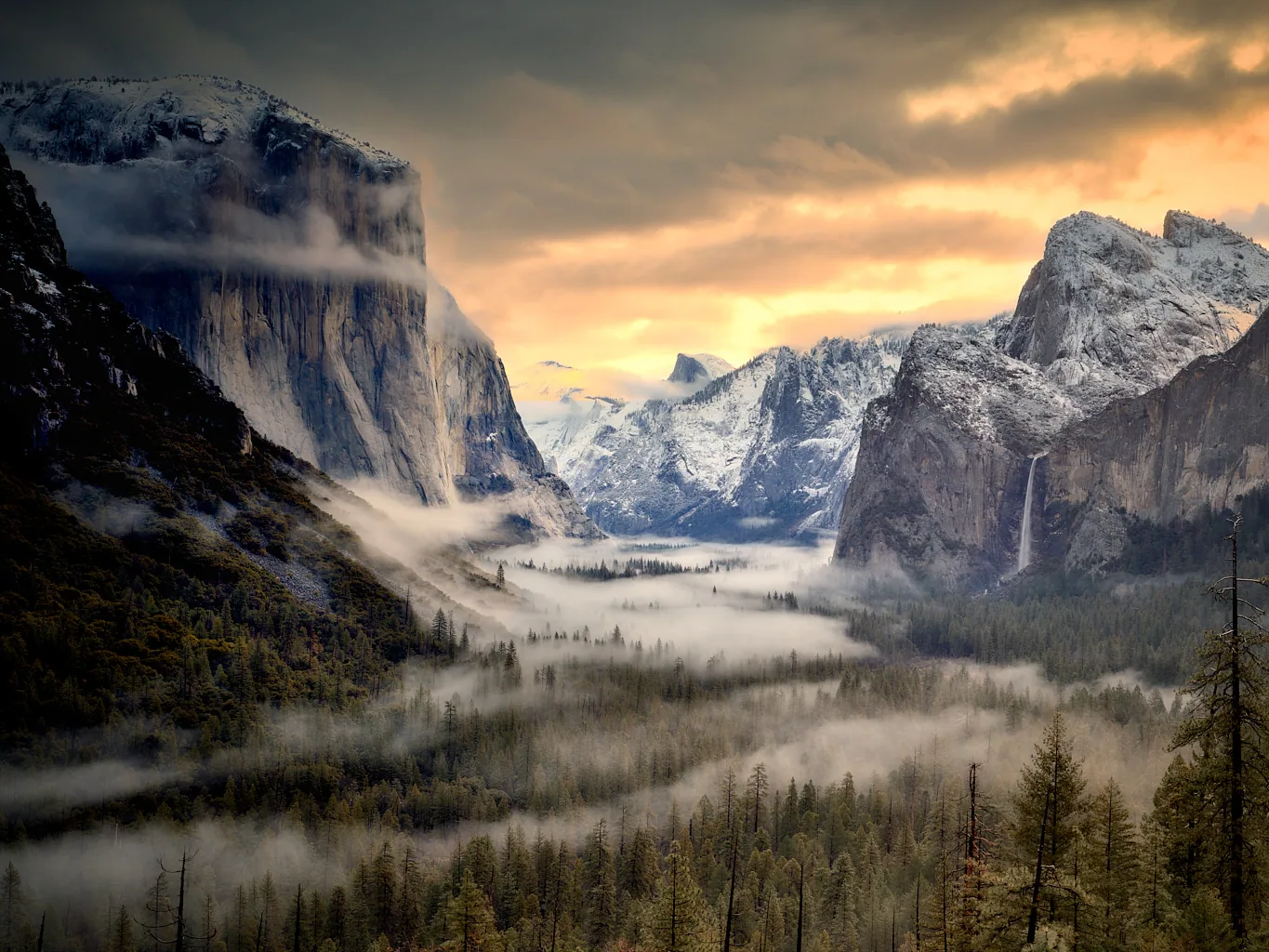
For national parks landscape photography, Yosemite Valley is almost a rite of passage. The scale alone is humbling. El Capitan rises nearly 3,000 feet straight from the valley floor, and the Merced River winds below it with a quiet patience that contrasts beautifully against the immovability of the granite above.
The most rewarding light in Yosemite tends to arrive at the edges of the day. Pre-dawn stillness leaves the river glassy and reflective, while the first rays of morning catch the upper walls before the valley floor has fully woken. Autumn adds another layer entirely: the deciduous trees along the river corridor turn gold and amber, framing those massive cliffs in warmth that feels almost impossible in real life.
Yosemite photography benefits most from patience. The valley changes quickly, and a composition that looks ordinary in flat midday light can transform into something extraordinary when a cloud breaks just right. Hammond Raffetto Art has captured several Yosemite scenes, including valley views at morning calm and the soft spillway light near Cathedral Rock and Bridalveil Fall, images that reflect this commitment to waiting for the moment rather than forcing it.
But let's also be candid here. With over 4 million visitors per year, Yosemite is almost overrun by tourists. Park staff do an amazing job controlling the herd, but you cannot defeat the math. The time to go is in the late fall, mid-winter—except February, unless you are specifically going for Horsetail Fall—and very early spring.
Sequoia and Kings Canyon: Entering Deep Time
If Yosemite is about scale in the horizontal sense, Sequoia National Park is about vertical scale of a different kind entirely. The giant sequoias are the largest trees on Earth by volume, and standing beneath them produces a specific feeling that no photograph fully prepares you for. That gap between expectation and experience is exactly what great fine art photography tries to close.
Sequoia national park photography presents a real creative challenge. The trees are so large they resist easy framing. The Generals Highway winds through groves where the canopy filters light into long golden shafts, and the forest floor is a tapestry of fern, fallen bark, and deep shadow. The best compositions often involve finding the threshold moments, a road disappearing into the grove, a shaft of light isolating a single trunk, or the contrast between the ancient bark and the soft green understory below.
Hammond Raffetto Art's portfolio includes several images from this region, among them views along the Generals Highway that place the viewer directly inside that corridor of living giants, inviting a sense of passage and reverence that is central to the brand's artistic vision.
Olympic and Redwood: Forests That Feel Like Cathedrals
The Pacific Northwest and Northern California coast are home to old-growth forests that carry an almost otherworldly atmosphere. Fog drifts between trunks wider than cars. Streams run over moss-covered stones in near silence. The quality of light in these places is soft and diffuse, filtered through a canopy so dense it creates its own microclimate.
For photographers who are drawn to mood over spectacle, these forests offer something rare: scenes that feel intimate even at grand scale. The light does not shout here. It whispers, and the images that emerge from these places tend to reward quiet contemplation rather than immediate impact.
Armstrong Redwoods State Natural Reserve in Sonoma County offers a similar experience closer to the Bay Area, and Hammond Raffetto Art's work from that grove, titled 'Lucem in Nemore' (light in the grove), captures exactly the kind of luminous, nave-like quality these forests produce.
Death Valley: Austerity as Beauty
Not every compelling landscape is lush. Death Valley offers a completely different emotional register: stark, silent, and immense. The salt flats at Badwater Basin stretch to the horizon with a geometry that feels almost extraterrestrial. Aguerberry Point surveys an enormous sweep of the park from above, while the changing light across the valley floor moves through colors that range from pale gold to deep ochre to a cool blue at dusk.
Black and white treatment—such as this image of Badwater Basin—can strip Death Valley to its essential forms, making the abstract patterns in salt and rock the main subject. The result is landscape photography that asks a different question than a lush forest or a dramatic waterfall. It asks what remains when everything is reduced to light, shadow, and the shape of the land. It does not make it easy, but it rewards the effort: our photograph from Death Valley's Racetrack Playa.
Rocky Mountain and Grand Teton: Classic Grandeur
For collectors who want images that convey the traditional sense of American wilderness, Rocky Mountain and Grand Teton national parks deliver that feeling consistently. Reflected peaks in still alpine lakes, meadows of wildflowers beneath jagged ridgelines, and sweeping vistas from high passes all fall within this category.
These parks reward early arrivals. The landscape photography potential in the hour around sunrise is genuinely exceptional here, particularly when low cloud sits in the valleys and the peaks catch warm light above it.
Planning Your Visit for the Best Light
Regardless of which park you choose, a few principles hold across all of them:
- Chase the edges of the day. Sunrise and sunset produce the most dynamic light, and the transition period just before and after offers soft, even tones ideal for subtle compositions.
- Return to the same location. A single visit rarely reveals everything a scene has to offer. Revisiting across seasons or even within a single trip deepens your understanding of a place.
- Weather creates mood. Overcast days, incoming storms, and clearing fog often produce far more interesting results than clear blue skies.
- Slow down. The temptation to cover as much ground as possible works against the patient attention that memorable landscape images require.
This kind of unhurried approach to landscape photography is something Hammond Raffetto Art has written about directly, noting that the most resonant images often come from settling into a place rather than moving quickly through it.
Planning Your Visit For the Right Time
Maybe you are looking for Yosemite in snow. Think March, but remember that snow can close the park entirely. If you're still outside, you're not getting in. And if you're inside, you're not leaving until they open back up. And if this is what you want, bring your snow chains, they're required.
If you want Yosemite in autumn colors, you've got a narrow, roughly two-week window at the end of October and beginning November. Here's the problem, it's different every year, depending on everything from autumn rains to last year's snow melt. Roll your dice; it's all you can do.
Maybe you want to see Horsetail Fall? That means February, because that's the only time of the year when the sun is properly aligned for the event. And it's subject to weather, so it's not guaranteed. It's also the one time of winter when the crowds are as bad as they are in summer. Note; this is not the famed Firefall of the 20th century when flaming coals were tossed at Glacier Point. This is a natural event, much more subtle and completely unpredictable. Still, you can get lucky, and then it is so worth it.
The national parks represent something genuinely rare: landscapes that still carry a sense of the untouched, the ancient, and the quietly astonishing. Whether you are planning a visit with a camera in hand or looking for a fine art print that brings one of these places permanently into your home, Hammond Raffetto Art's portfolio spans many of these locations with the care and technical depth that serious collectors look for. Browse the collection and find the image that opens a door you did not know you wanted to walk through.